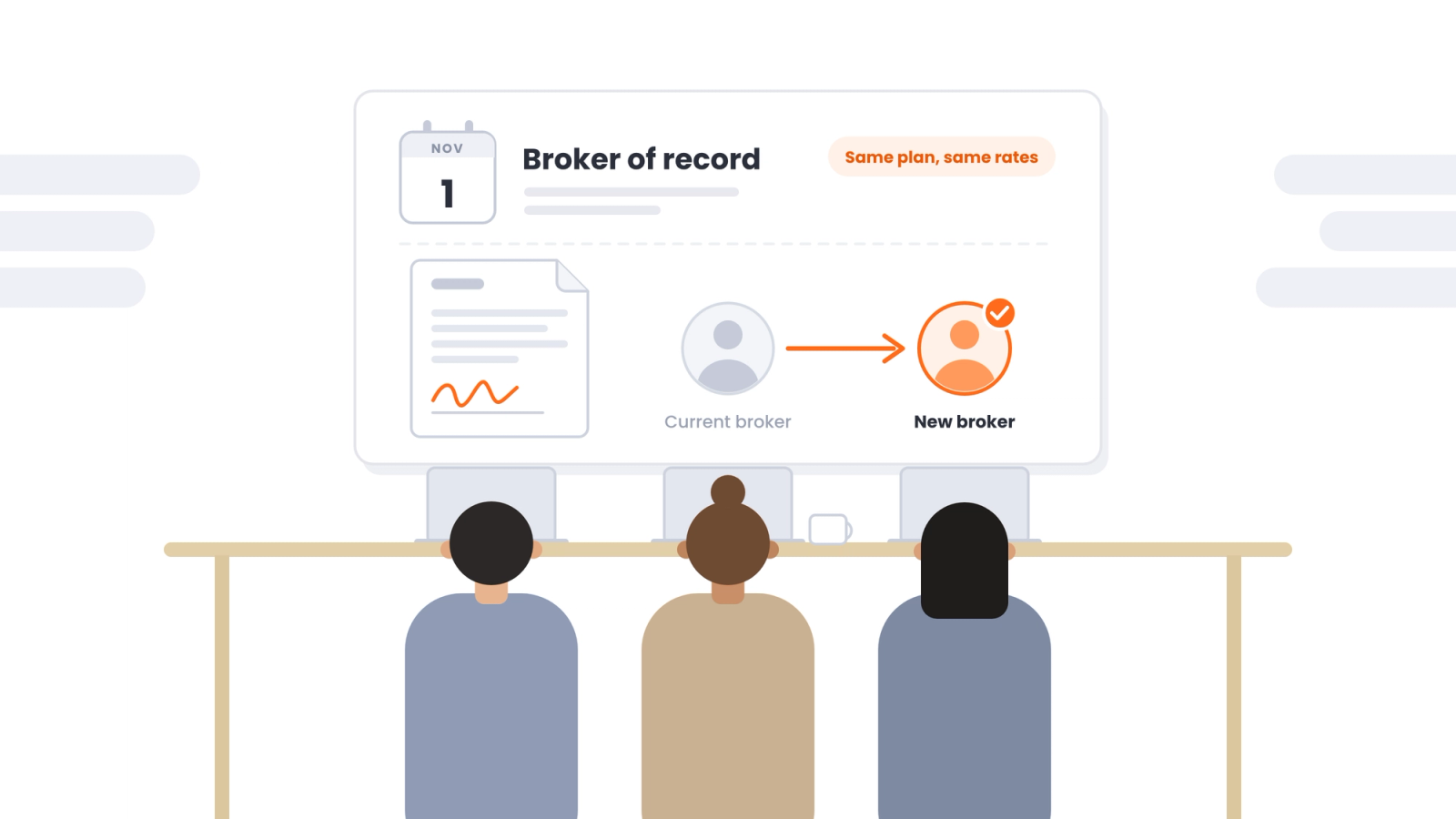
Changing brokers doesn't mean changing your plan. It runs on a one-page letter, takes effect on the 1st of the month at most carriers, and the part that actually goes wrong is the handoff.
If you're reading this, your broker probably did something annoying. Maybe the renewal arrived as a forwarded carrier PDF and a two-line email. You've asked twice about an employee's denied claim and heard nothing back. Or the person who set up your plan three years ago left the agency, and nobody can tell you who owns your account now.
You can fix that without switching plans, re-enrolling anyone, or waiting for next year. The whole change runs on a single page called a broker of record letter, and your employees won't notice it happened. What takes some care is the timing, and getting everything out of the old broker before they stop picking up.
What a broker of record letter does
A broker of record (BOR) letter is a signed instruction from your company to an insurance carrier saying which broker represents you. Once the carrier processes it, the new broker can act on your behalf: pull your renewal, see your census and plan details, get into the employer portal, and work with the carrier on your account. At Kaiser, for example, the broker of record gets the same online enrollment and membership access the employer has (Kaiser Permanente).
The commission moves too. The carrier pays whoever is broker of record, starting on the date the change takes effect.
Here's what moves and what doesn't:
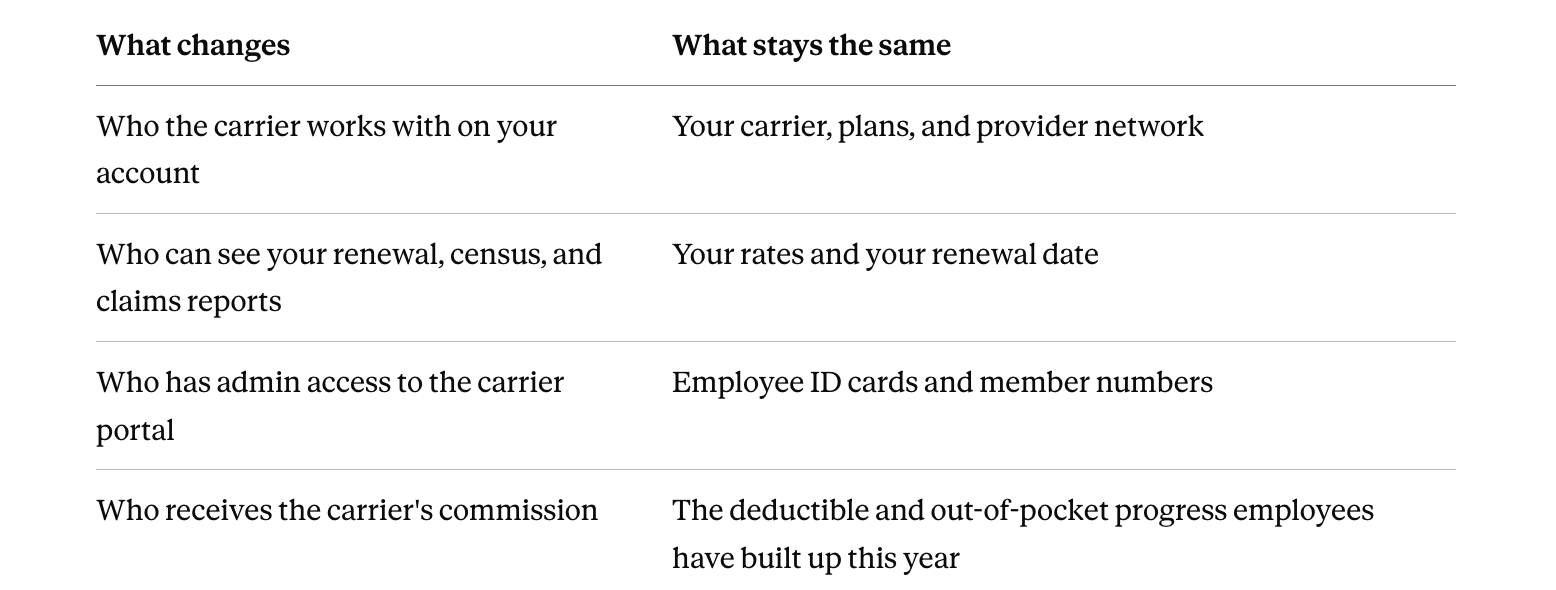
The commission row is the one people ask about. In small group, changing brokers doesn't change your premium. The broker's commission is built into the carrier's rates, so every company pays it whether it uses a broker or not (Small Business Majority). A new broker gets paid out of the same premium you're already paying. Small group means 50 or fewer employees in most states and up to 100 in California, New York, and Vermont (healthinsurance.org). Above that, commission becomes negotiable, which is one more reason to see it in writing (more on that below).
What goes in the letter
There's no standard format. Some carriers have their own form, most accept a letter on company letterhead, and a few won't take anything else. Aetna wants the letter on group letterhead and won't accept a DocuSign version, while Blue Shield of California prefers its own change form, signed by the group's designated contact (Word & Brown). Your new broker should know which carrier wants what. If they're asking you to figure it out, that tells you something.
Whatever the format, the letter needs:
- Your company letterhead. Many carriers reject plain paper.
- The date. Carriers don't backdate broker changes, so both the date on the letter and the date they receive it matter (Kaiser Permanente).
- Your group or policy number with that carrier, plus your company's legal name and EIN as they appear on the group contract.
- The new broker's name and agency, with their license number or NPN. Some carriers also ask for the agency's tax ID.
- The lines of coverage it covers: medical, dental, vision, life, disability.
- The effective date you want. Future dates are fine. Past dates aren't.
- A sentence rescinding prior appointments, so there's no question about who the carrier should listen to.
- A signature from someone authorized on the group contract, with their printed name and title. Kaiser returns letters that aren't signed by an authorized representative, and the resubmission can push the effective date out a month (Kaiser Permanente).
That last item is where most letters get bounced. The person who signed your original group application might be a co-founder who has since left, or an office manager who's no longer the contact on file. Check who the carrier has listed before anyone signs.
Broker of record letter template
Put this on your letterhead and send one per carrier:
[Date]
[Carrier name], Broker Services [Carrier address or broker services email]
Re: Broker of record change for [Company legal name], Group #[number], EIN [number]
Effective [effective date], please recognize [Broker name] of [Agency name], NPN [number], as our broker of record for all [medical, dental, vision, life, and disability] coverage under the group number above. This letter rescinds any previous broker of record appointments for these lines of coverage.
[Broker name] is authorized to request and receive information about our plans on our behalf, including renewals, census and enrollment data, plan documents, and claims reports.
[Signature] [Printed name], [Title] [Company legal name] [Phone] · [Email]
When the change takes effect
The default at most carriers: the change takes effect on the 1st of the month after they receive the letter, and processing takes one to two weeks. Here's how the major carriers handle it for California small groups, from Word & Brown's carrier requirements sheet (Word & Brown):
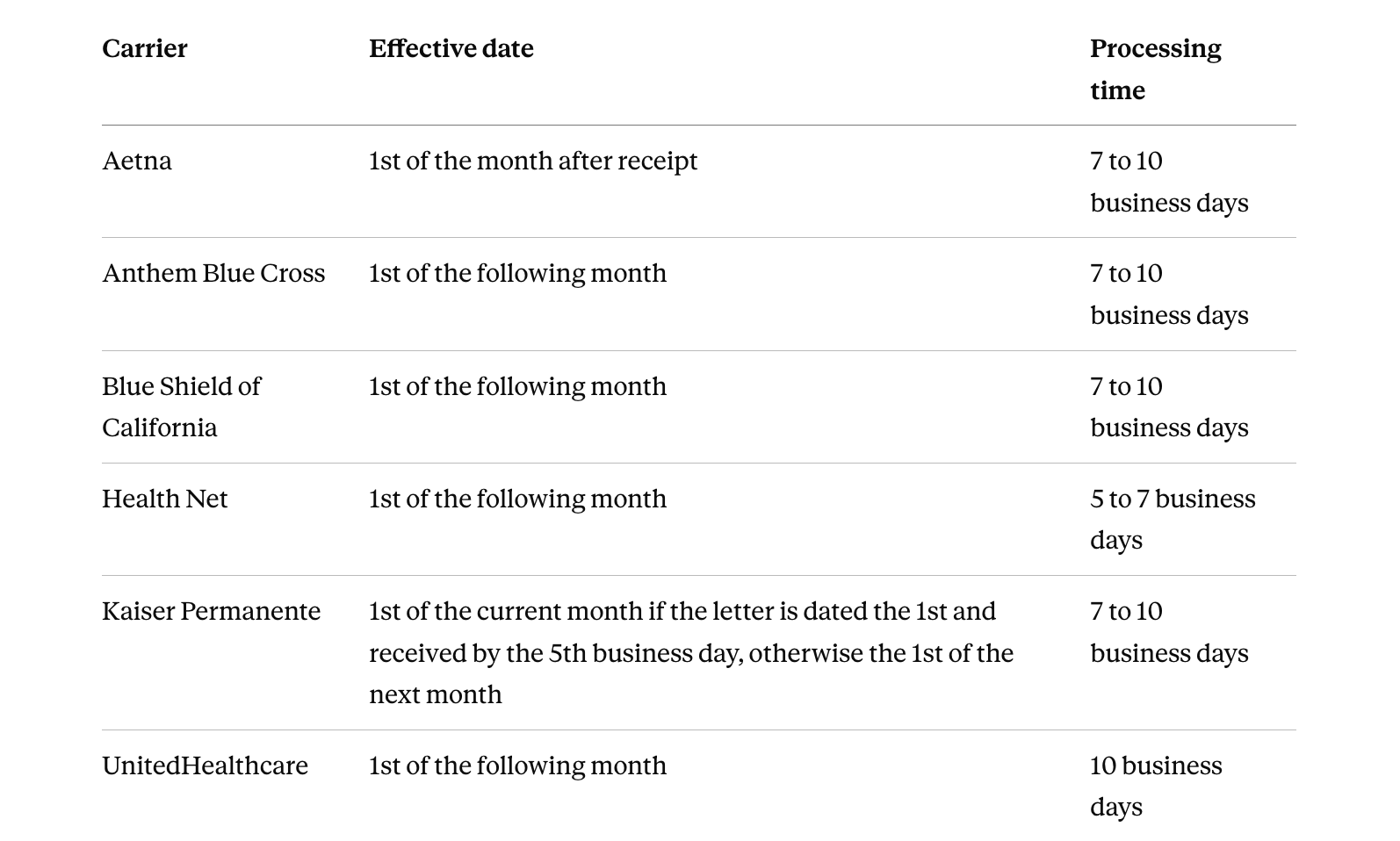
- Kaiser's same-month window is narrow. Its own page says the letter has to be dated the 1st and arrive by the fifth business day. Miss either and it rolls to the next month (Kaiser Permanente).
- Some carriers move the service relationship but hold the commission. CCHP in California doesn't move commission on an existing group until its renewal month (Word & Brown). That one lands on the new broker, but a broker who doesn't bring it up may not know the carrier well.
- An incomplete letter restarts the clock. If the carrier sends it back and you fix it on the 10th, you've lost a month. Keep proof of when the carrier received the letter, by email or fax confirmation, because that date sets the effective date.
The timing math for a January 1 renewal
If your plan renews January 1, here's what the calendar looks like from early October:
- Letter received in October: effective November 1 at most carriers. The new broker has November to re-market, model options, and set up open enrollment. This is the comfortable version.
- Letter received in November: effective December 1. The new broker gets a couple of weeks inside your current carrier's renewal before decisions are due. Workable, if they're already quoting.
- Letter received in December: effective January 1. The new broker takes over after you've already renewed, so they're working on 2028.
The letter doesn't gate all of the work, though. Medical carriers will quote the same group for more than one broker, unlike property and casualty insurance, where the first broker to submit can block everyone else (Oswald). So a new broker can start pricing other carriers as soon as you send them a census, before the letter is effective. What they can't do until then is anything that runs through your current carrier: pull the renewal file, negotiate it, request claims, or change your plans.
The practical order: choose the broker, send them your census and current renewal yourself so they can start quoting, and sign the BOR letters that same week. Don't wait for the letters to process before the work starts.
If you're in the middle of a renewal right now, Your 2027 Health Insurance Renewal Came In High covers what to check in the packet and the moves that change the number.
One letter per carrier, plus the vendors people forget
A BOR letter only covers the carrier it's addressed to. If medical is with UnitedHealthcare, dental and vision are with Guardian, and life and disability are with Lincoln, that's three letters. List every line you have with that carrier in each one, or the carrier may move only the line you named.
Then there's everything around the carriers, which a BOR letter doesn't touch:
- Stop-loss, if your plan is level-funded. The stop-loss carrier needs its own letter.
- COBRA administration. If your old broker set up COBRA through a vendor they work with, confirm who administers it after the switch, and get the list of people currently on COBRA.
- FSA, HSA, HRA, and commuter accounts run by a third-party administrator.
- Your benefits administration software, if the old broker provided it. Ask whether your account and enrollment history survive their departure.
- Workers' comp and business insurance. Those are property and casualty lines, often with a different broker. They don't move unless you move them.
One more: your payroll platform may be your broker. Several can act as broker of record, Gusto among them (Gusto Help Center). If yours is, ask how benefit deductions will sync to payroll once they're no longer the broker, before you sign anything. The plan doesn't move, but you want deductions to keep flowing without someone re-keying them every pay period.
What to get from your old broker before they're gone
This is where switches go wrong. Carriers process the letter on their own schedule, and nothing makes the old broker send you anything. Plan documents and data don't transfer automatically (OneDigital). Ask for these in writing the day you tell them:
- The last two or three renewals, with rate history.
- The current census as the carrier has it, including dependents and coverage tiers.
- Plan documents: SBCs, certificates of coverage, your ERISA wrap document or SPD, and your Section 125 plan document if you deduct premiums pre-tax.
- Form 5500 filings, if your plan has 100 or more participants.
- Claims and utilization reports, if you're level-funded or big enough that the carrier releases them.
- Your contribution and eligibility rules: waiting periods, hours thresholds, and any exceptions they've been quietly making.
- Open issues: pending enrollments, claim escalations, anything someone promised an employee.
- Portal logins and the names of your account reps at each carrier.
Once the new broker is recognized, the carrier can supply some of this directly. Some of it can't be replaced. A Section 125 document or a running list of exceptions may only exist in the old broker's files, and three years of context is a lot to lose in an email thread.
Telling your current broker
You don't need their permission. The carrier takes the instruction from you. You do need to tell them, though. Kaiser's own page puts that job on the employer, and the carrier's own courtesy notice can lag if processing is slow (Kaiser Permanente).
A short email is enough:
"Hi [name], we've decided to move our benefits to [new broker], effective [date], and we've sent broker of record letters to [carriers]. Before the transition, could you send over the documents listed below by [date]? Thanks for your help over the last [X] years."
Keep it boring, since you may still need them to answer a question in December.
If you signed a service agreement or pay the broker a fee on top of commission, read the termination clause first. Commission-only relationships usually have nothing to exit, but fee arrangements often come with a notice period.
And before you sign with the new broker, ask for their written compensation disclosure. Since December 27, 2021, brokers and consultants who expect $1,000 or more in direct or indirect compensation from an ERISA group health plan have to disclose it reasonably in advance of the contract (U.S. Department of Labor). A broker who sends it before you ask is a good sign.
When a broker of record letter won't help
- You're in a PEO. The PEO holds the master policy, so there's no group plan in your name to move. Leaving means setting up your own group coverage, which runs on its own timeline. The PEO Exit Playbook lays out the 90 days, and PEO vs Sdine: The Real Cost Math helps you decide whether it's worth doing this year.
- The renewal is already signed. Once you've renewed and open enrollment is done, a new broker can't reopen it. Switching can still make sense for service and next year's renewal, but don't expect a different rate this year.
- The broker isn't the problem. If your rates are high because of your census or your plan design, a new broker inherits the same numbers. What matters is what they'd do with them: re-market, change the lineup, rework contributions, or rethink how the plan is funded. Ask any broker you're considering what they'd change, specifically, before you sign.
FAQ
Does changing health insurance brokers change our premium?
Not in small group. The commission is already built into the carrier's rates and stays the same whoever your broker is. In large group, commission can be negotiated, which is another reason to read the compensation disclosure.
How long does a broker of record change take?
Carriers usually process the letter in one to two weeks and make it effective on the 1st of the following month. Kaiser in California can make it effective on the 1st of the current month if a letter dated the 1st arrives within the first five business days.
Do we need our current broker's permission to switch?
No. The carrier acts on a letter signed by an authorized person at your company. You should still tell your current broker and ask for your files.
Can we switch brokers in the middle of the plan year?
Yes. A broker change doesn't touch the plan year, so you can do it in any month. Two to three months before renewal is the best window, because the new broker has time to work on it.
Will employees need to re-enroll or get new ID cards?
No. Their plan, carrier, member IDs, and deductible progress stay the same. The only thing they'll notice is who answers their questions.
Can we use different brokers for medical and dental?
Yes. Each carrier gets its own letter, so you can split lines between brokers. Most companies don't, because one broker can coordinate renewals and open enrollment across all of them.
Is a broker of record letter the same as an agent of record letter?
Yes. Some carriers call it an agent of record (AOR) letter. It does the same thing.
Switching to Sdine
If you've decided to switch, send us your current renewal and census. We'll draft the broker of record letter for each carrier in the format it wants, you sign, and we start re-marketing while the letters process.
From there, Sdine is your broker of record: the renewal, open enrollment, carrier issues, and employee questions in Slack, on top of Rippling, Gusto, Deel, ADP, or whatever you already run. It's free, because carriers pay broker commissions that are already built into your premium.
Sources
- Kaiser Permanente: broker of record information for California employers
- Word & Brown: broker of record change requirements by carrier, California small group (June 2025)
- Small Business Majority: how brokers are paid
- healthinsurance.org: what counts as small group
- Oswald: why P&C quotes get blocked and medical quotes don't
- OneDigital: switching benefits brokers before renewal
- Gusto Help Center: transferring your broker of record
- U.S. Department of Labor: Field Assistance Bulletin 2021-03 on broker compensation disclosure
The Sdine team writes about leaving the PEO, modern benefits, and keeping compliance on autopilot, the AI-native alternative to brokers and PEOs.