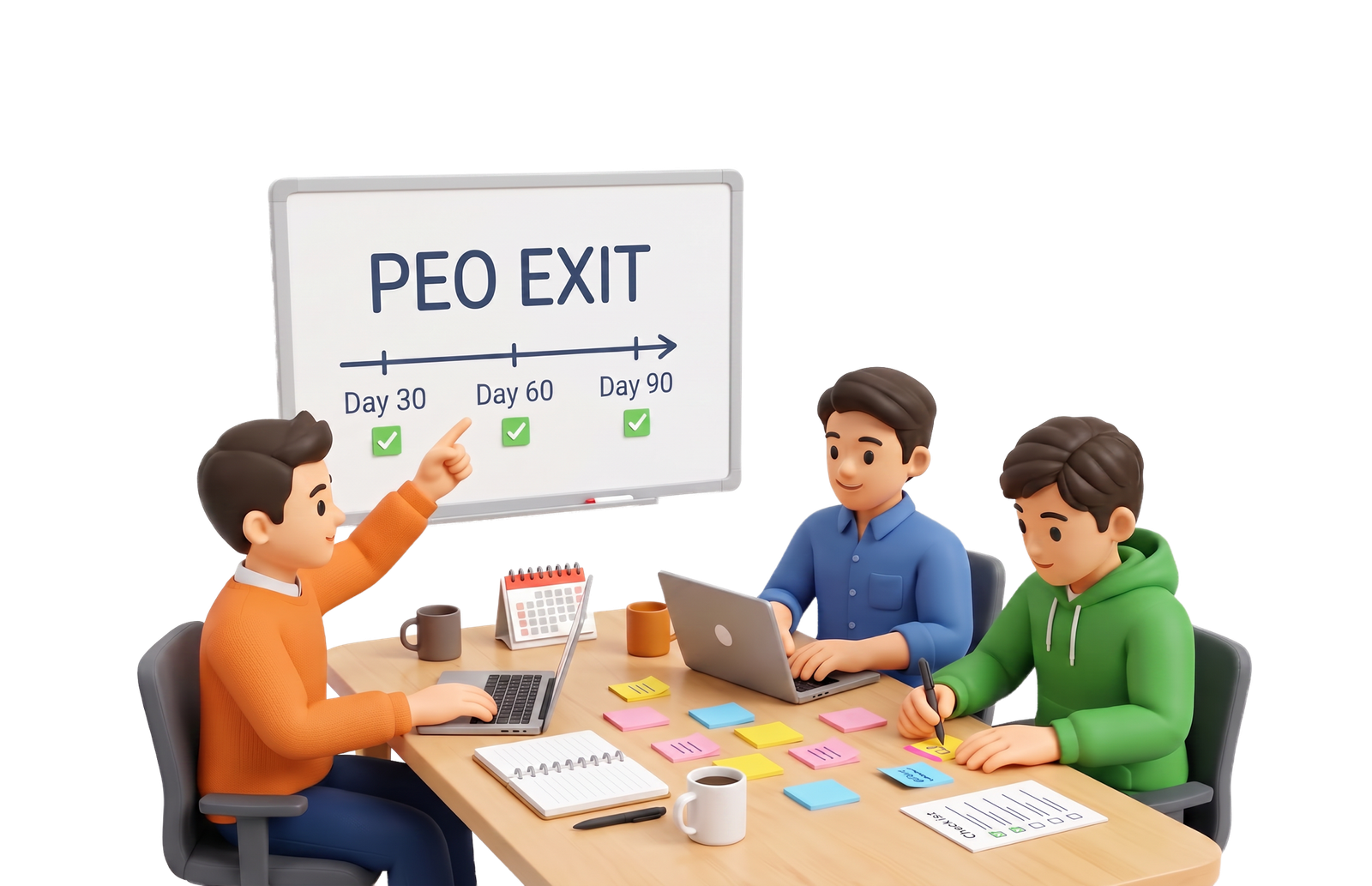
There are two ways to leave a PEO.
One is to make the decision, give 60 days notice, and discover halfway through that you missed underwriting deadlines for January 1 effective dates, that your COBRA participants don't have continuation rights set up, and that your first payroll under the new system has misaligned FICA wage bases. The other is to work backward from your target effective date and treat the exit like a product launch, with a timeline, dependencies, and a clear owner for each phase.
The difference between the two approaches is roughly $50,000 in scrambling costs and one bad month of employee experience that your team will remember for years.
We built Sdine to handle the second version end-to-end.
This is the operational playbook we run for clients exiting Justworks, Rippling, TriNet, and other PEOs. It works whether you run it yourself with a traditional broker, build internal capacity, or partner with us, but the sequencing matters either way. Below each phase, we note specifically what Sdine owns for our clients, so you can see where AI-native brokerage replaces work that would otherwise sit on your HR team. One structural difference worth stating up front: Sdine is not a PEO. There's no co-employment. You leave the PEO and keep your own entity, your own EIN, and your own group health plans, Sdine sits on top of the payroll stack you already run (Gusto, Rippling, ADP, Justworks, Deel), so there's no platform migration bundled into the exit.
Why timing dominates everything else
Three calendars constrain a PEO exit, and they don't align:
Carrier underwriting calendar. Health insurance carriers need 30–60 days to underwrite a new group plan. For a January 1 effective date, carriers want submissions in by mid-October. Miss that window and you're looking at a March 1 effective date, three months of paying double or scrambling on COBRA.
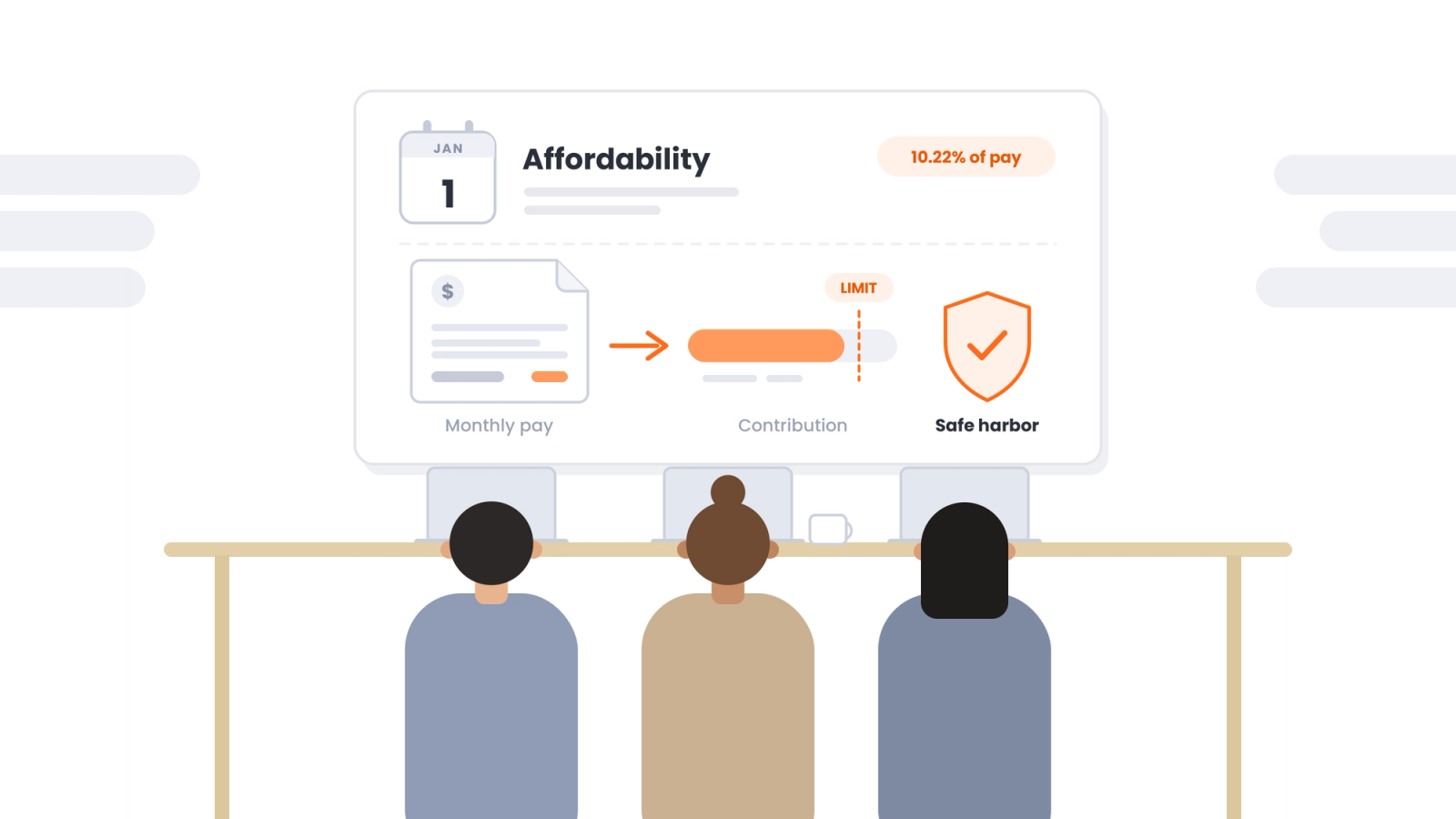
Tax filing calendar. Mid-year PEO exits create split FICA wage bases (unless your PEO is CPEO-certified, Justworks is, TriNet is, Insperity is). For non-CPEO exits, the cleanest exit is January 1 to avoid duplicate wage-base contributions on employees who exceed the Social Security cap.
Your PEO's notice window. Most PEO contracts require 60–90 days written notice before termination, with auto-renewal clauses if you miss the window. Q4 is when this trap closes on founders most often.
The intersection of these three calendars is why the right time to start planning a January 1 exit is the previous July. Most founders start in October, which is too late for the clean version.
The timeline below assumes you're working backward from a target effective date (the day your new benefits kick in and your PEO relationship ends). Day 0 = effective date.
Day -120 to -90: Decision and partner selection
The first 30 days of an exit are about deciding what you're moving to. Most founders compress this phase too aggressively because the decision feels obvious once they've decided to leave the PEO. It's not.
Tasks owned by founder/COO:
- Pull your current PEO contract and identify the notice window and any early-termination fees
- Decide your post-PEO architecture: keep your own entity with a broker + your existing HRIS/payroll (Gusto, Rippling, ADP, Justworks, Deel) OR a new PEO OR EOR-style arrangement
- If broker-led: interview 2–3 brokers, get written proposals
- Run the cost analysis (see Post 2 in this series for the framework)
What you're solving for in partner selection:
- Does the broker handle compliance docs (ERISA wrap, SPD, Section 125 POP)?
- What's the employee support model, call center, dedicated rep, AI concierge?
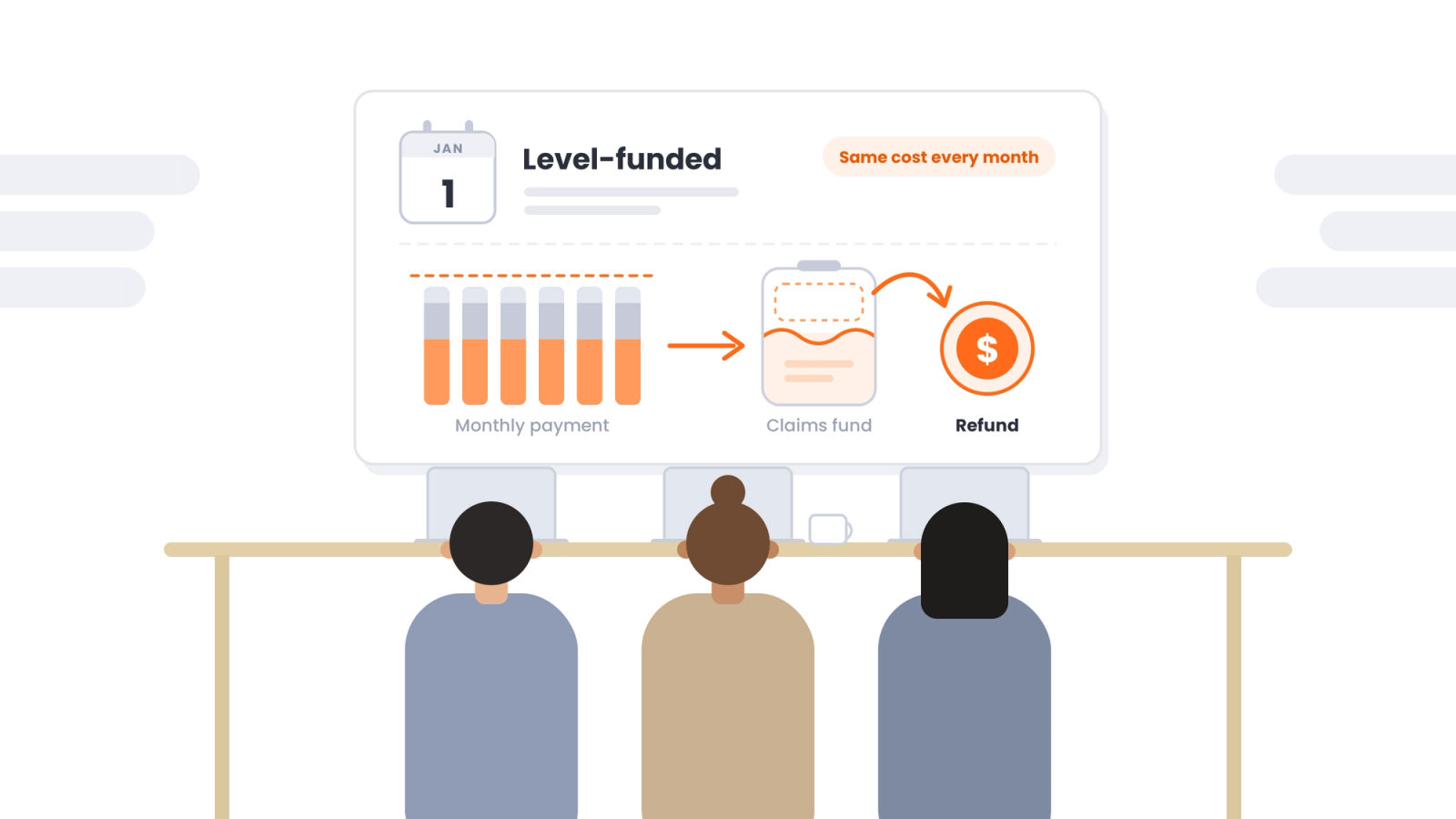
- Do they recommend level-funded vs fully insured based on your census?
- Can they show you historical renewal rates from comparable clients?
- What's their fee structure, pure commission, fee-based, hybrid?
Decision artifact at end of phase: Signed letter of intent or service agreement with new broker/partner. No notice to current PEO yet.
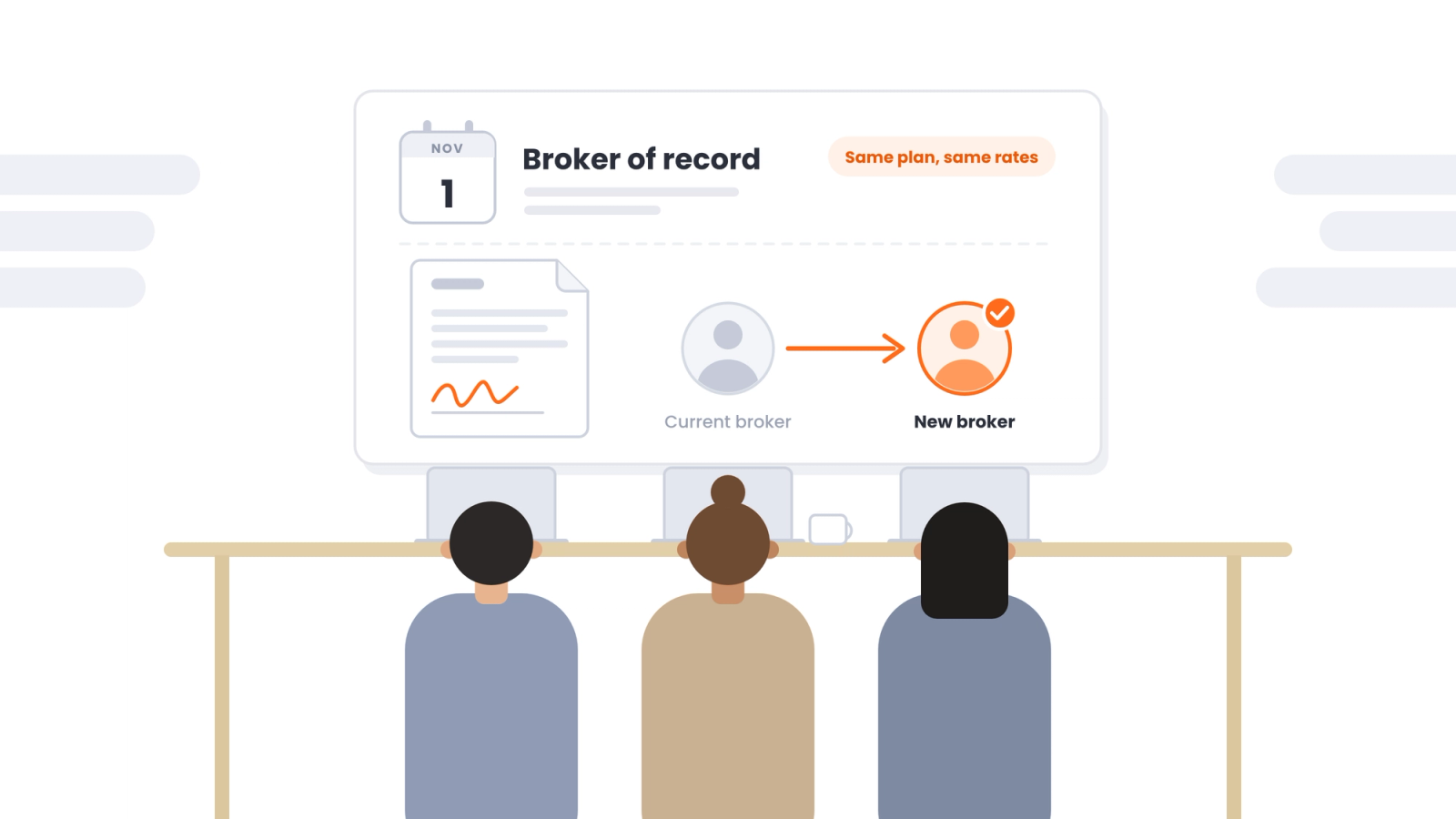
What Sdine handles in this phase. We deliver the cost analysis in roughly 48 hours from your PEO invoice and census file, no spreadsheet exercise on your side. Your dedicated senior consultant also reviews your PEO contract clause and flags the exact notice window and termination fee structure so you don't get surprised. Sdine is free to the employer, like any broker, we're paid by carrier commission, not by setup, admin, or per-employee fees, so the decision to move with Sdine happens after you see the modeled savings, not before. Once you sign a broker-of-record (BOR) letter, we can have you live in roughly 7–10 days.
Day -90 to -75: Notice and underwriting submission
Now you give notice. Most contracts require it in writing; some require certified mail. Read the contract clause, getting this step wrong can extend your PEO relationship by another 90 days.
Tasks owned by founder + new broker:
- Submit written termination notice to PEO (follow contract exactly)
- Request from PEO: 12 months of claims data, current census file, plan documents, COBRA participant list, FSA/HSA balances
- New broker submits underwriting application to 2–3 carriers
- Begin plan design conversations, what tiers, what funding type, what employer contribution
The claims data extraction is critical and often slow. Some PEOs delay or limit claims data delivery on exit; this is a known industry pattern. Push hard, in writing, and escalate if needed. Underwriters quote 15–25% better rates with claims data than without, this single document is worth tens of thousands of dollars in your renewal pricing.
What Sdine handles in this phase. We shop every carrier for your group, submitting underwriting applications in parallel to UnitedHealthcare, Aetna, Cigna, BlueCross, and level-funded specialists like Allstate Benefits or HealthEZ depending on geography. Our AI plan optimization models thousands of plan configurations against your census, the kind of analysis that used to require a benefits actuary, and surfaces the 2–3 designs that best fit your workforce, across fully-insured, level-funded, self-funded, ICHRA, and QSEHRA structures. We also handle the claims data escalation with your departing PEO. By day -60 you have written quotes; by day -45 you have a final plan design.
Day -75 to -45: Compliance and ancillary lines
This is the phase where most exits run into trouble, not because anything is hard individually, but because there are 12+ separate workstreams running in parallel and no one is tracking them as a portfolio.
| Workstream | What needs to happen | Typical owner |
|---|---|---|
| Health insurance | Carrier selection, plan design, employer contribution finalized | Broker |
| Dental, vision, life, disability | Ancillary carrier RFP and selection | Broker |
| Workers' compensation | Standalone policy (PEO unbundles), review experience mod rate | Broker / insurance specialist |
| EPLI (employment practices) | Standalone policy from day one outside PEO | Broker |
| FSA / HSA / Commuter | New TPA selection ($500–$1,500 setup + $4–$6 PEPM ongoing) | HR / broker |
| 401(k) | Establish own plan OR move from PEO's multiple employer plan (~60 days, includes 30-day blackout) | HR / 401k provider |
| ERISA wrap document | Drafted by new broker or compliance vendor | Broker |
| SPD (Summary Plan Description) | Drafted and distributed to employees | Broker |
| Section 125 POP | Established for pre-tax premium deductions | Broker / payroll provider |
| ACA reporting (1094-C/1095-C) | Determine who files for the year (PEO for pre-exit period, you for post) | CFO / payroll |
| COBRA administration | Identify new administrator; existing COBRA participants enroll in new plan | Broker |
| Payroll tax setup | Tax accounts established in every state with employees | Payroll provider |
Multi-state payroll tax accounts are the silent killer here. If you have employees in 12 states, you have 12 state unemployment insurance accounts to establish, plus state withholding accounts. Each takes 2–6 weeks. Start this on day -75, not day -30.
What Sdine handles in this phase. This is where AI-native brokerage replaces the most operational work. Sdine Compliance generates and tracks the full document set, ERISA wrap, SPD, Section 125 POP, ACA filings, Form 5500, COBRA notices, with automatic expiration windows and renewal reminders, and monitors 10,000+ jurisdictions for multi-state tax and hiring changes across all 50 states. We handle the ancillary RFPs, standalone EPLI quote, workers' comp unbundling, and FSA/HSA TPA selection in one consolidated workstream. Sdine People Ops stands up the multi-state payroll tax accounts on your existing stack, you're not migrating platforms, you're detaching from the PEO's EIN and running payroll under your own. The 12-workstream portfolio above runs against a single view with named owners and dates, instead of living in your inbox.
Day -45 to -15: Employee communications
This is the highest-leverage phase and the one founders most often underinvest in. Employees experience the PEO exit through three moments: when they hear about it, when they enroll, and when their first paycheck hits.
Two weeks before open enrollment opens (Day -45 to -30):
- Send the announcement email. Keep it simple. Lead with what stays the same: their job, their pay, their access to care. Then explain what changes: new ID cards, new portal, new (or same) doctors.
- Host a 30-minute all-hands Q&A. Address fears directly, "yes, your therapist is still covered; here's how to verify."
- Publish a one-page FAQ in your wiki or Notion.
Open enrollment period (Day -30 to -15):
- Push enrollment completion daily. Industry benchmark: only 60–70% of employees complete open enrollment without active reminders.
- For each plan option, show the actual numbers, "your monthly premium on Plan A is $X, Plan B is $Y, with these tradeoffs." Most employees pick wrong when shown only deductibles and out-of-pocket maxes.
- Flag COBRA participants explicitly, they need to enroll in your new plan or transition off. If they stay on the PEO's plan, that's a significant per-month fee, and you may be paying it.
Critical communication element founders miss: pay frequency, pay date, and direct deposit information. Because Sdine keeps you on your existing payroll stack rather than migrating you, the cadence usually stays the same, but confirm it, and if anything shifts, give employees two weeks' notice to avoid bank overdrafts. This is the kind of mistake that destroys trust in a transition.
What Sdine handles in this phase. The Sdine app runs the enrollment for every employee individually. Its AI Care Navigator walks each person through their specific options with cost projections based on their actual usage patterns (single vs family, anticipated care utilization, prescription needs), and recommends the plan that minimizes their total cost, with human experts on hand for the harder conversations. The result across our deployments: high enrollment completion rates, and the share of employees on the most expensive PPO drops from a typical 65% to around 40%, because the concierge helps people pick the plan that actually fits them. From the moment the app goes live, 80%+ of employee benefits questions get resolved without ever reaching HR.
Day -15 to 0: Cutover
The last two weeks are about validation and contingency, not new work. By day -15, all decisions should be locked.
Verification checklist:
- All new ID cards in employee hands (digital or physical) by day -7
- New payroll tax setup has been parallel-tested on day -14 (run a fake payroll, verify tax withholding matches)
- COBRA participants have elected their new coverage status
- HSA/FSA balances have been transferred or rolled over
- PEO has confirmed final invoice and refund process for prepaid services
- Workers' comp policy is active and effective on day 0
- 401(k) blackout period (if any) has been communicated and is closing on schedule
On day 0: First payroll under your own EIN runs. CFO or COO should personally verify the first payroll batch before it submits, every founder we've worked with has caught at least one error here.
What Sdine handles in this phase. Digital insurance cards are live in the Sdine app by day -7, so employees can show coverage at a doctor's office or pharmacy from minute one. The concierge is pre-loaded with the new plan's network and formulary, so the first time an employee tries to fill a prescription or book a visit under the new plan, the Care Navigator confirms coverage in real time rather than triggering an HR ticket.
Day 0 to +30: Stabilization
The first 30 days post-exit are when everything that wasn't fully tested surfaces.
The pattern is predictable: weeks 1–2 are about ID cards and pharmacy claims (employees show up at the pharmacy with old PEO ID, get rejected, panic, ticket flood). Weeks 3–4 are about billing and claims processing (first medical bills under the new plan arrive, employees don't understand new EOBs).
What to monitor:
- Pharmacy fills: are employees getting medications filled with new insurance?
- In-network provider visits: are claims processing correctly?
- HR ticket volume: should be elevated for 2 weeks, then back to baseline
- Payroll tax filings: verify the first month's filings are accurate in every state
What breaks most often:
- Mid-year out-of-pocket maximums and deductibles reset (employees who already hit their PEO plan's deductible may have to start over, confirm with your new carrier whether they accept proof of payment for the partial year)
- Specialty pharmacy authorizations don't transfer; expensive medications can hit a gap
- Mental health and therapy in-network status differs between carriers; employees on long-term care need confirmation early
What Sdine handles in this phase. The Sdine app concierge, AI Care Navigator plus human experts, absorbs the first-month spike automatically. Most "is this covered" and "where do I go" questions resolve in seconds through the app instead of becoming HR tickets. For the harder edge cases (specialty pharmacy authorization gaps, mental health continuity, balance billing disputes), the concierge escalates to carriers and providers on the employee's behalf, negotiating bills where they can be reduced. By day +30, HR is fielding a fraction of the volume it did inside the PEO, structurally lower, not just back to "normal."
The seven most common mistakes
After enough exits, the failure modes cluster:
- Giving notice before signing the new partner. Don't. You lose negotiating leverage.
- Underestimating the claims data extraction timeline. Start on day -90, not day -45.
- Mid-year exits without a CPEO. Wage-base restart costs $1,000–$3,000 per employee above the SS cap.
- Skipping the parallel payroll test. First-payroll errors are the most visible employee experience failure.
- Treating the employee communication as a one-time email. It's a 4-week campaign.
- Forgetting EPLI. Day-one coverage outside the PEO is non-negotiable.
- Not transferring HSA/FSA balances correctly. Employees lose money; trust collapses.
What a well-run exit feels like
Done right, a PEO exit is uneventful from the employee's perspective. Same paychecks (now under your own company's EIN instead of the PEO's), same doctors, slightly better benefits, much faster answers when they have a question. The HR ticket volume drops, the CFO sees the savings on the next quarterly close, and the founder forgets they ever ran a transition project.
Done wrong, it's a months-long retention issue.
This is the work Sdine was built to own. Our AI plan optimization handles the plan design and carrier negotiation; Sdine Compliance handles the document portfolio and multi-state filings; the Sdine app handles the employee experience day one and ongoing, backed by a dedicated senior consultant and a vetted network of 50+ fractional-HR partners for anything that needs a human. The founder's job is to decide the strategic direction and sign one BOR letter. Everything else runs against a shared view with named owners and dates, and it's free to the employer.
The clients we've moved off PEOs see up to a 25% reduction in healthcare cost, roughly $4,000 in savings per employee in year one, employees save around $340 a year through pharmacy savings and bill negotiation in the app, and 80%+ of employee questions resolve without HR. The bigger story is what happens in year two and three: because the optimization is continuous and the claims data is yours, costs continue to decline rather than compound upward like a PEO renewal cycle.
Sdine manages PEO transitions for startups in the 30–150 employee range, including the 90-day playbook above, plus ongoing app-based concierge support that means your HR team doesn't get buried in tickets the day you cut over. The benchmark analysis is free. Talk to us about your exit timeline →
The Sdine team writes about leaving the PEO, modern benefits, and keeping compliance on autopilot, the AI-native alternative to brokers and PEOs.