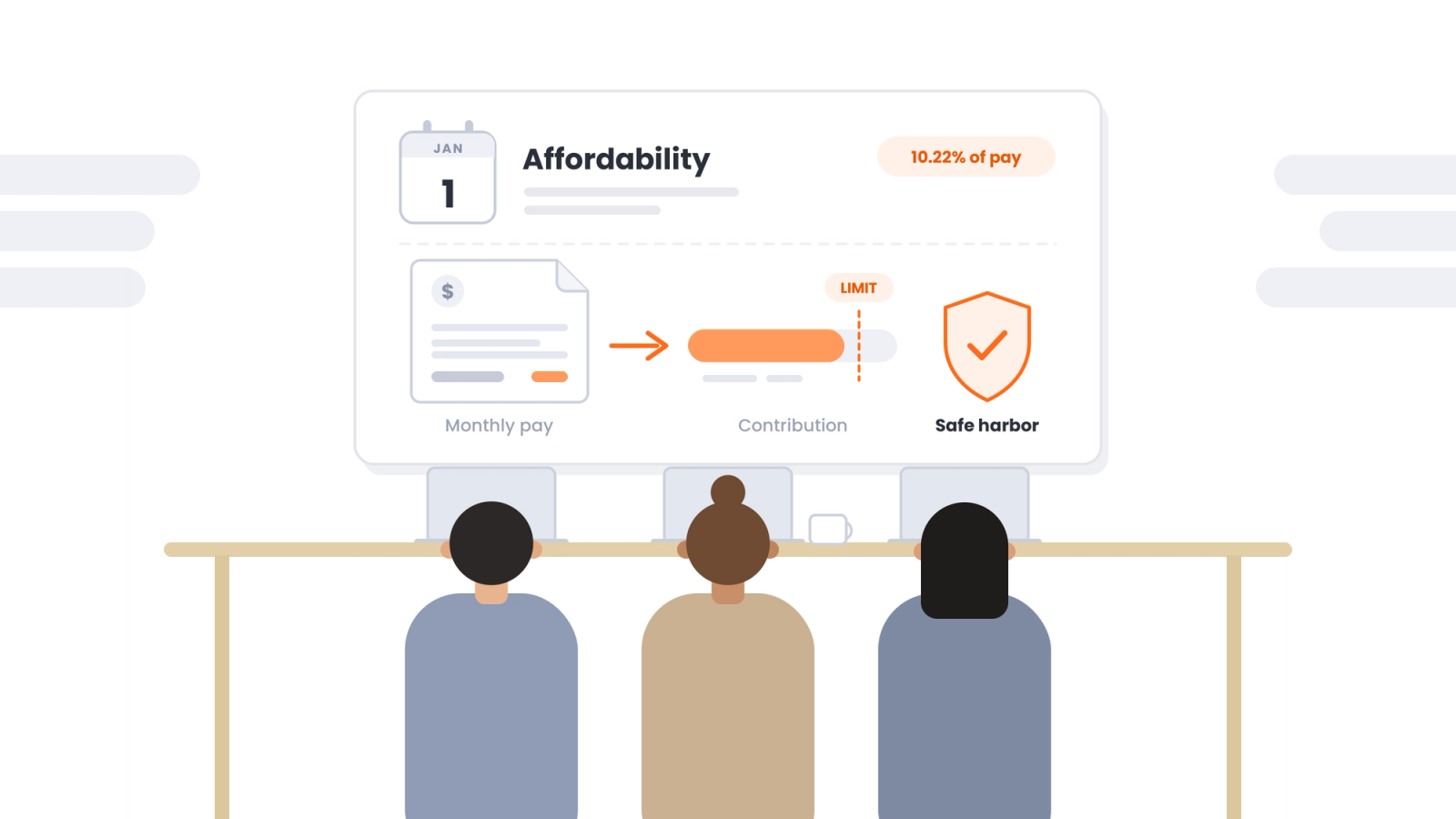
For 2027, your cheapest self-only plan can't cost a full-time employee more than 10.22% of pay. Here's how the three safe harbors measure that, with the math on real wages.
You're setting 2027 contributions. The renewal came in higher, so you're keeping the same split as last year: the company pays 60% of the base plan, employees pay 40%. It feels fair. It's also the decision that decides whether you owe the IRS money in 2029.
Once you have 50 or more full-time employees, the ACA doesn't just ask whether you offer coverage. It asks whether the cheapest plan is affordable for each full-time employee, measured against that person's pay. For plan years starting in 2027, the line is 10.22% (IRS Rev. Proc. 2026-26). Your lowest-paid full-time employee is the one who decides whether you pass.
Who this applies to
The affordability test only matters for applicable large employers, or ALEs. You're an ALE for 2027 if you averaged at least 50 full-time employees, counting full-time equivalents, during 2026. Full-time means 30 hours a week or 130 hours in a month, and part-time hours get combined into equivalents (IRS).
That last part catches startups. A 44-person company with a handful of part-time contractors on payroll and a support team working 25 hours a week can cross 50 without anyone noticing.
Being an ALE doesn't mean you owe anything. A penalty only applies if at least one full-time employee buys marketplace coverage and receives a premium tax credit (IRS). And an employee can only get that credit if your offer was unaffordable or didn't provide minimum value.
The timing makes this real. Marketplace open enrollment for 2027 starts November 1, 2026, and the enhanced premium tax credits expired at the end of 2025 with no extension enacted as of October (SBMA). Subsidies still exist for households up to 400% of the poverty line (IRS Rev. Proc. 2026-26). That's a support rep or an ops associate, not your engineers. Those are exactly the employees the affordability test is built around.
The 2027 numbers
Sources: IRS Rev. Proc. 2026-26, Thomson Reuters, Groom Law Group, SBMA.
The percentage went up, which helps you a little. The penalties went up more, which raises the stakes.
What actually gets tested
Affordability looks at one number per employee: what that employee pays each month for the lowest-cost self-only plan you offer that provides minimum value (IRS). A few things follow from that:
- Only the cheapest plan counts. If you offer a base plan and a buy-up, the buy-up's price doesn't matter for this test.
- Only self-only coverage counts. What you charge for family coverage isn't part of the employer test, even when family premiums are painful.
- The plan has to provide minimum value. That means it pays at least 60% of covered costs and includes substantial hospital and physician coverage (IRS). Most carrier plans meet it. A skinny plan doesn't.
- The percentage follows the plan year. If your plan year starts July 1, 2027, you use 10.22% for that whole plan year.
The statute measures affordability against household income. You can't see household income, so the IRS gives you three safe harbors that use numbers you do have. Pass one and the offer is treated as affordable, even if the employee's actual household income would say otherwise (IRS).
To use any of them, you have to offer coverage to at least 95% of full-time employees and their dependents. You can use different safe harbors for different reasonable categories, like hourly and salaried, as long as you apply each one consistently within its group.
The three safe harbors
W-2 safe harbor
The employee's monthly contribution can't exceed 10.22% of their Form W-2 Box 1 wages for the year, divided by 12.
It sounds simple. It has three problems:
- Box 1 is net of pre-tax deductions. 401(k) deferrals and pre-tax health premiums come out of Box 1, so an employee who saves aggressively shrinks their own affordability limit (McGriff).
- You only know the answer after the year ends. Raises, unpaid leave, or a mid-year cut in hours all change Box 1.
- The contribution has to stay consistent. It must be a consistent amount or percentage of W-2 wages through the year (McGriff).
For employees who weren't offered coverage all year, Box 1 wages are prorated to the months coverage was offered (Lawley).
Rate of pay safe harbor
For hourly employees, take the lower of their hourly rate on the first day of the coverage period or their lowest rate during the month, and multiply by 130 hours. The contribution can't exceed 10.22% of that. Overtime doesn't count (McGriff).
For salaried employees, use monthly salary as of the first day of the coverage period. If you reduce someone's salary during the year, this safe harbor stops working for them (Lawley).
This is the one most companies our size should use. You know the answer before the plan year starts, and it doesn't care about anyone's 401(k) elections.
Federal poverty line safe harbor
The contribution can't exceed 10.22% of the single-person federal poverty line, divided by 12. Calendar-year plans use the prior year's poverty line (McGriff). For 2027 plans that's the 2026 figure of $15,960 (ASPE), which works out to $135.92 a month (SBMA).
It's the easiest to administer, with one number for everyone and no tracking. It's also the most expensive. Holding the base plan under $136 a month for every full-time employee means the company pays almost all of the self-only premium.
The math on five employees
Assume the base plan's self-only premium for 2027 is $720 a month. At a 60/40 split, the employee pays $288. At 50/50, they pay $360. Here's how each person comes out (monthly limits rounded down):
[TABLE 2: insert a Table block here, cells below]
The math behind each row:
- $18 per hour: $18 × 130 = $2,340 a month. 10.22% of that is $239.14.
- $22 per hour: $22 × 130 = $2,860. 10.22% is $292.29.
- $52,000 salary: $4,333.33 a month. 10.22% is $442.86.
- Same salary on the W-2 method: $8,000 of 401(k) deferrals and pre-tax deductions bring Box 1 to $44,000. 10.22% of that is $4,496.80 a year, or $374.73 a month. Same person, same job, $68 a month less room.
Two things stand out. The 60/40 split you've used for years fails for your lowest-paid full-time role. And the fix is small. Dropping the support rep's contribution from $288 to $239 costs the company $49 a month, or $588 a year, for that employee.
What a failed offer costs
There are two penalties, and they work very differently.
4980H(b), the "unaffordable offer" penalty. You offered coverage to at least 95% of full-time employees, but someone's offer failed the test and they got a premium tax credit. You pay $5,670 a year, or $472.50 a month, for each full-time employee who actually got the credit (Groom Law Group). If the support rep goes to the marketplace and qualifies, that's $5,670 to save $588.
4980H(a), the "no offer" penalty. You offered coverage to fewer than 95% of full-time employees, and at least one full-time employee got a credit. This one is calculated on your whole full-time workforce minus 30, at $3,780 each (IRS, Groom Law Group). At 60 full-time employees, that's 30 × $3,780 = $113,400, triggered by a single person.
The (a) penalty is the one to fear. It usually comes from people you didn't know were full-time: a variable-hour employee who averaged 31 hours, or a contractor who should have been on payroll. The (b) penalty is smaller and almost always avoidable with the math above.
The IRS doesn't find out in real time. It matches your Forms 1095-C against marketplace subsidy data and sends a Letter 226J, usually long after the plan year closes. So a 2027 mistake tends to show up in 2029, when the people who set contributions may not even be there anymore.
Three situations that trip up startups
You're 50 to 100 people in California, New York, or Vermont
In those states, small group runs up to 100 employees (healthinsurance.org). So you can be an ALE for the employer mandate and still buy small group coverage. The two rules don't talk to each other. Your carrier's minimum participation and contribution rules decide whether you can get a plan. The IRS decides whether that plan is affordable. Check both, because a contribution that satisfies the carrier can still fail the 10.22% test for your lowest-paid employee.
New hires and waiting periods
A waiting period can't be longer than 90 days under the ACA (U.S. Department of Labor). Companies that start coverage on the first of the month after 60 days are fine. Companies that copied a "first of the month after 90 days" rule from an old handbook often aren't, because that can run past 90 days. A new full-time hire who isn't offered coverage in time counts against your 95% offer rate.
Variable-hour employees
Support, ops, and fulfillment roles often swing between 25 and 35 hours a week. If you treat them as part-time and they average 30 or more, they're full-time employees you didn't offer coverage to. Enough of them and you drop under 95%, which is where the (a) penalty starts. Most payroll platforms can run a look-back measurement on hours. Turn it on before the plan year starts, not after a Letter 226J arrives.
How to set 2027 contributions so they pass
This works for most 50 to 150 person companies:
- Pull a list of every full-time employee and their pay. Include variable-hour employees likely to average 30 hours. Sort by hourly rate or monthly salary, lowest first.
- Name your affordability plan. Pick the cheapest plan that provides minimum value. That's the only plan this test looks at.
- Pick the safe harbor by class. Rate of pay for hourly employees. Rate of pay or W-2 for salaried. FPL only if you're willing to make the base plan nearly free.
- Price the base plan to your lowest-paid full-time employee. If $239 a month is the limit for your lowest rate, set the self-only contribution at or below it. Leave a few dollars of margin in case of an hourly rate change.
- Use pay bands if one contribution doesn't work. You can charge lower-paid employees less for the same plan, for example one rate under $60,000 and another above it. If your plan is level-funded, run the bands past Section 105(h) nondiscrimination rules first. Level-Funded Health Plans covers what changes on a self-funded plan.
- Watch what quietly raises the contribution. Unconditional opt-out payments count as part of the employee's cost. Wellness discounts generally don't reduce it, except tobacco-related ones. If you're adding either for 2027, rerun the math.
- Record which safe harbor you used. Forms 1095-C for 2027, due in early 2028, carry a code for it on line 16: 2F for W-2, 2G for FPL, 2H for rate of pay (IRS). If a Letter 226J arrives, a documented safe harbor is your answer.
If your renewal came in high and you're tempted to push more of the increase onto employees, run step 4 before you do. Your 2027 Health Insurance Renewal Came In High covers the levers that cut the premium itself, which is usually the better trade.
FAQ
What is the ACA affordability percentage for 2027?
10.22% for plan years beginning in 2027, up from 9.96% in 2026. It's set in IRS Rev. Proc. 2026-26.
Does affordability apply to family coverage?
Not for the employer penalty. The test only looks at the employee's cost for the lowest-cost self-only plan that provides minimum value.
Which safe harbor should we use?
Rate of pay for most companies. You can check it before the plan year starts, and it isn't affected by 401(k) deferrals or pre-tax deductions.
Do we have to use a safe harbor?
No. But without one, affordability is measured against household income, which you can't see. A safe harbor gives you a test you can actually run and document.
We have 45 employees. Does this apply to us?
Only if full-time employees plus full-time equivalents averaged 50 or more in the prior year. Count part-time hours too. Many companies cross the line before headcount says they have.
What if an employee declines our coverage and buys a marketplace plan?
If your offer was affordable and provided minimum value, they can't get a premium tax credit, so there's no penalty. If it failed the test, they can, and you may owe the 4980H(b) amount for each month they had it.
Can we charge different contributions for the same plan?
Yes, for example by pay band. Fully insured plans have more room here. Self-funded and level-funded plans also need to pass Section 105(h) nondiscrimination testing.
How Sdine handles this
When we take over as broker of record, we run the affordability check on every full-time employee before contributions are set. We flag anyone who fails under each safe harbor, model pay bands if you need them, and keep the safe harbor documentation ready for your 1095-C filing.
Sdine becomes your broker of record: the renewal, open enrollment, carrier issues, and employee questions in Slack, on top of Rippling, Gusto, Deel, ADP, or whatever you already run. It's free, because carriers pay broker commissions that are already built into your premium. If you're switching mid-renewal, the broker of record letter is the one-page step.
Book a free 2027 affordability check
Sources
- IRS Rev. Proc. 2026-26: 2027 required contribution percentage
- IRS: Questions and answers on employer shared responsibility provisions
- IRS: Minimum value and affordability
- IRS: Instructions for Forms 1094-C and 1095-C
- U.S. Department of Labor: 90-day waiting period final rule
- healthinsurance.org: what counts as small group
- ASPE: HHS poverty guidelines
- Thomson Reuters: IRS announces 2027 affordability indexing
- Groom Law Group: 2027 employer mandate penalty amounts
- SBMA Benefits: ACA employer penalties heading into 2027
- McGriff: affordability safe harbors Q&A
- Lawley: affordability for 2026, rate of pay and W-2 details
The Sdine team writes about leaving the PEO, modern benefits, and keeping compliance on autopilot, the AI-native alternative to brokers and PEOs.