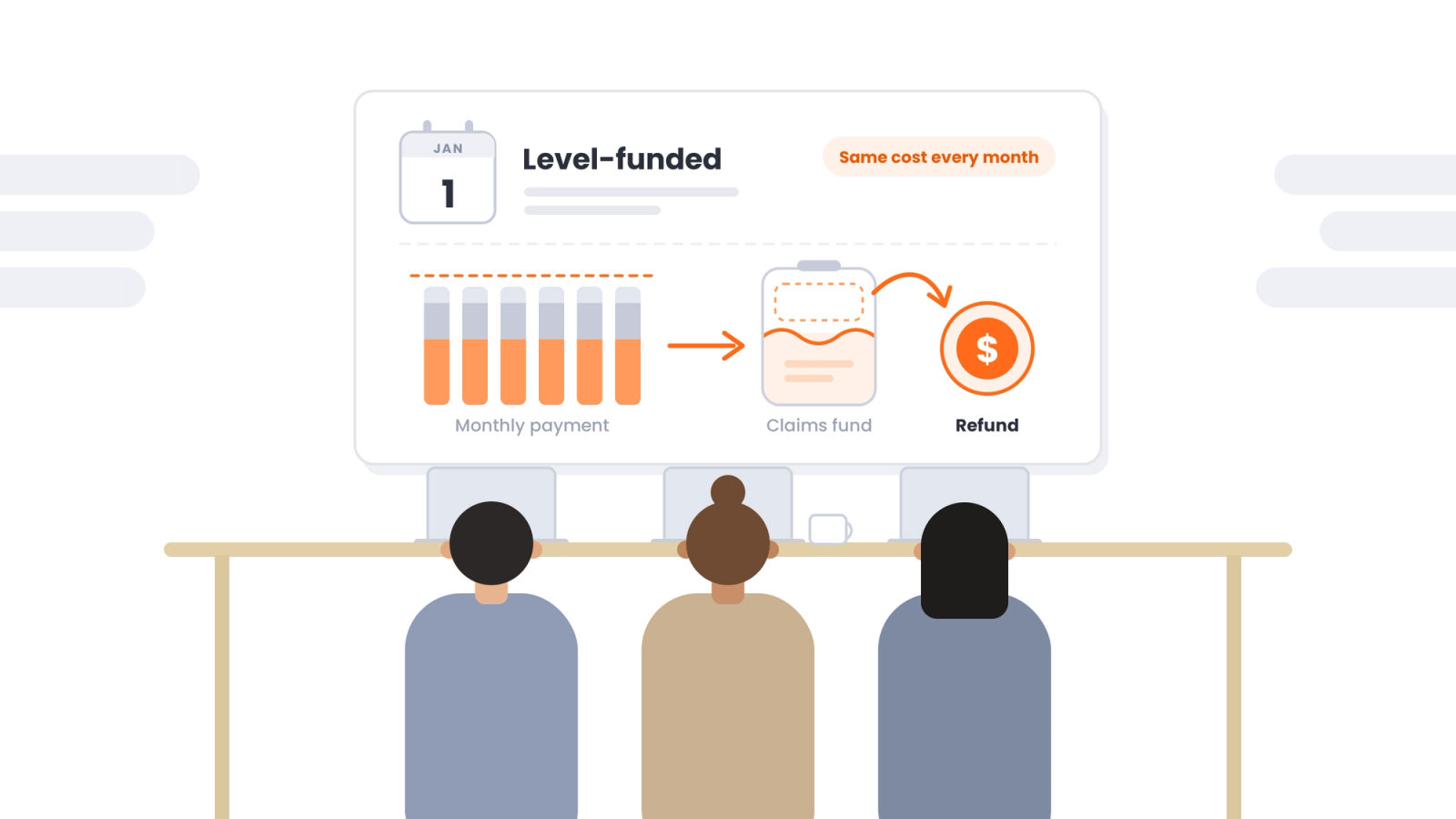
A level-funded plan costs the same every month, caps your downside, and can hand money back after a good year. Here's how the money moves, what to check in a quote, and who it fits.
Your renewal came back, and next to the usual fully insured option your broker added a second column labeled "level-funded." The monthly number is lower. There's a line about a possible refund. And there's a health questionnaire every employee is supposed to fill out by Friday.
That second column is now the default for a lot of companies your size. Among firms with 10 to 199 workers, 37% of covered employees are in a level-funded plan (KFF). Whether it's right for you comes down to three things: how healthy your group is, how large it is, and how carefully you read the contract.
What a level-funded plan is
A level-funded plan is a self-funded health plan packaged to behave like insurance. Technically, your company pays employees' claims. In practice, you pay one fixed amount every month, and a carrier or administrator handles everything else. KFF describes it as "a relatively small self-funded component with stop-loss insurance" (KFF).
That fixed monthly payment has three parts:
- The claims fund. Money set aside to pay employees' medical and pharmacy claims. This is the self-funded part, and it's the most you'll pay in claims for the year.
- Stop-loss insurance. Coverage that kicks in when claims go above set limits, either for one person or for the whole group.
- Administrative fees. Claims processing, network access, the member portal, ID cards, and usually broker compensation.
Kaiser's level-funded flyer puts it plainly: the fixed monthly payment covers administrative fees, stop-loss insurance, and the maximum claims liability, regardless of how much care employees use (Kaiser Permanente).
Your employees mostly won't notice the difference. They get an ID card from a carrier they recognize, usually on that carrier's national network, with deductibles and copays that look like any other plan. The difference is on your side of the contract.
How stop-loss caps your risk
Stop-loss is what makes this safe for a 40-person company. It comes in two layers.
Specific stop-loss covers any one person's claims above a set amount, called the specific deductible or attachment point. If the specific deductible is $50,000 and an employee has a $350,000 hospital stay, the claims fund pays $50,000 and stop-loss pays the other $300,000. UnitedHealthcare's California level-funded product sets individual stop-loss between $75,000 and $100,000 (UnitedHealthcare via Word & Brown).
Aggregate stop-loss covers the whole group's claims above a total for the year. If everyone has a heavy year and claims blow through the claims fund, aggregate stop-loss pays the difference. You don't get a bill for it. Kaiser's own example: $250,000 funded, $290,000 in paid claims, and the $40,000 deficit is covered by stop-loss, with no extra payment from the employer (Kaiser Permanente).
Some states set floors on how low these attachment points can go for small employers, so a stop-loss policy can't quietly turn into fully insured coverage. The NAIC model law sets a $20,000 specific minimum. California's is $40,000, with an aggregate floor of the greater of $5,000 per member, 120% of expected claims, or $40,000 (NAIC).
Where the refund comes from
If claims come in under the claims fund, there's money left over at the end of the year. That's the surplus, and you get some of it back.
"Some" is doing a lot of work in that sentence. Each carrier sets its own terms:
[TABLE 1: insert a Table block here, cells below]
Sources: UnitedHealthcare via Word & Brown, Kaiser Permanente.
Two things stand out. First, the refund arrives well after the year ends, because claims keep arriving for months after care happens. UnitedHealthcare holds back a reserve for those late claims and pays you the unused part after the run-out period. Second, some refunds only exist if you stay. A surplus paid as a renewal credit is worth nothing if you leave.
Neither carrier guarantees a surplus. Treat it as upside, never as budget.
The math on a 45-person company
Here's an illustrative example. The numbers are made up but realistically proportioned for a young, healthy group of 45 enrolled employees.
The fully insured renewal is $61,000 a month, or $732,000 for the year. The level-funded quote is $57,500 a month, or $690,000 for the year, split like this:
- Claims fund: $455,000
- Stop-loss premium: $205,000
- Administrative fees: $30,000
Now run the year three ways, with a 50% surplus share:
[TABLE 2: insert a Table block here, cells below]
In the heavy year, aggregate stop-loss pays the $105,000 overrun. Your cost stays at $690,000, which is still $42,000 under the fully insured quote. In the light year, you end up almost $100,000 ahead.
That's the pitch in one table: a lower ceiling and a possible rebate. Two catches don't show up in it.
The first is the renewal. A heavy year doesn't cost you more this year, but it will show up in next year's quote. Level-funded renewals are priced on your own claims. Fully insured small group renewals aren't.
The second is that this table only exists for groups that underwrite well. The quote at the top depends entirely on who your employees are and what they've claimed.
Why the quote depends on your group's health
In the small group market, which means 50 or fewer employees in most states and up to 100 in California, New York, and Vermont (healthinsurance.org), the ACA bans pricing fully insured plans on health status. A carrier can adjust for age, location, and tobacco use, but not for the fact that one of your employees is in cancer treatment. Everyone is pooled together.
Level-funded plans sit outside that pool. Because they're self-funded, they don't have to follow the ACA's ban on health status rating or cover the full set of essential health benefits, and stop-loss carriers price groups by looking at their claims experience (Georgetown CHIR). For a group with no claims history, that's the health questionnaire.
So a level-funded quote is a bet that your group is healthier than the average small employer. For a 30-person startup where most people are under 35, that bet usually pays. For a group with one or two known high-cost conditions, the quote will come back high, come back with conditions, or not come back at all.
The flip side protects you. Small group fully insured coverage is guaranteed issue, so if a level-funded renewal turns ugly, you can generally move back to fully insured at your next renewal. Georgetown's researchers point out that's exactly what stop-loss carriers count on: healthy groups leave the pool, and groups that develop expensive claims go back to it (Georgetown CHIR). Good for your budget. Worth knowing as the reason fully insured small group rates keep climbing.
Above 50 employees, the comparison changes
Once you're large group in your state, fully insured carriers can already price on your claims experience. The question stops being "do we underwrite well?" and becomes "do we want the surplus and the data?" Level-funded still gives you a refund on a good year and claims reports most fully insured carriers won't share. But the underwriting advantage that drives most small group savings mostly disappears, and at 100-plus employees, partially self-funded plans with higher stop-loss deductibles start to make more sense.
What to check in a level-funded quote
Two quotes with the same monthly payment can be very different contracts. Before you sign, get answers to these in writing:
- Surplus share and timing. What percentage do you get back, when, and as cash or a credit?
- Conditions on the refund. Do you have to renew to receive it? What happens to the surplus if you leave?
- Specific deductible. How large is a single claim before stop-loss pays? Lower means less claims fund exposure but a higher stop-loss premium.
- Aggregate attachment. At what percentage of expected claims does aggregate stop-loss kick in? UnitedHealthcare's California product uses 125% (UnitedHealthcare via Word & Brown).
- Run-out coverage if you terminate. Claims for care received before you leave keep arriving for months. Confirm they're covered without a final bill. Kaiser builds run-out into the monthly payment (Kaiser Permanente). Ask everyone else the same question.
- Renewal rate caps. Some carriers cap year-two and year-three increases. UnitedHealthcare's California product includes caps in years 2 and 3 (UnitedHealthcare via Word & Brown). Get the actual cap, not "renewal protection."
- Lasers. A laser is a higher specific deductible set for one person with a known expensive condition. Ask whether the stop-loss carrier can laser at renewal, and whether the contract says it won't.
- Network. Confirm the network is the same one your employees use today. Most carrier products are, but some level-funded plans run on a rented network through a third-party administrator.
If the quote came from a third-party administrator rather than a major carrier, add one more: who's the stop-loss carrier, and what's its financial rating? Your safety net is only as good as the company holding it.
What changes on the compliance side
Level-funded plans follow the self-insured rulebook, not the fully insured one (Newfront). Your administrator handles most of the work, but legally it's your plan. A few items move onto your plate:
- ACA coverage reporting. With fully insured coverage, the carrier reports who was covered. On a level-funded plan, that's you: Form 1095-B to each covered employee and the IRS, or Part III of Form 1095-C if you have 50 or more full-time employees (HUB International). California, New Jersey, Rhode Island, Vermont, and DC use this data to enforce their individual mandates.
- The PCORI fee. Self-funded plans pay a small annual per-person fee on IRS Form 720, due July 31. It's $3.84 per covered life for plan years ending between October 1, 2025 and September 30, 2026 (EY).
- Nondiscrimination testing. Self-insured plans fall under Section 105(h), which bars favoring highly compensated employees in eligibility or benefits. A richer plan for executives only, common in fully insured setups, can fail it, and the executives are taxed on the benefits (Newfront).
- HIPAA. You're the sponsor of a self-insured plan, so HIPAA privacy and security rules apply to you more directly. Keep detailed claims data with the administrator and work from de-identified reports.
- State mandates. Self-insured plans aren't subject to state insurance mandates, thanks to ERISA (Newfront). That gives the plan design more flexibility. It also means a benefit your state requires of fully insured plans may not be in yours, so check before telling employees nothing changed.
None of this is heavy, but someone has to own it. If you're already juggling 1095-C filings after crossing 50 employees, add these to the same calendar.
Who should take the level-funded quote
Level-funded tends to work for:
- Young, healthy groups with no known high-cost conditions.
- Small group companies, roughly 20 to 50 enrolled employees, where the ACA pooling you leave behind is costing you the most.
- Stable headcount. Big swings in enrollment make the claims fund harder to price.
- Founders who want data. Claims and utilization reports show what's driving cost, which helps when you're designing next year's plan.
Fully insured is usually the better call when:
- You know about expensive claims. An employee in active treatment, a high-risk pregnancy, or an expensive specialty drug will drive the quote up or the carrier away.
- Your group is very small. Below about 10 to 15 enrolled employees, one bad claim moves everything, and many carriers won't quote.
- You need predictability at renewal more than a lower number now. Fully insured small group renewals don't spike because of your own claims.
- You're leaving a PEO this year. Moving off the PEO's master plan is already a big change. Level-funded can still be the right answer, but get both quotes side by side. PEO vs Sdine: The Real Cost Math shows how the totals compare.
The timing for a January 1 renewal
Level-funded quotes take longer than fully insured ones because of underwriting. The carrier needs a census, and for groups without credible claims history, completed health questionnaires from employees. Missing questionnaires stall the quote, and some carriers won't quote with low participation.
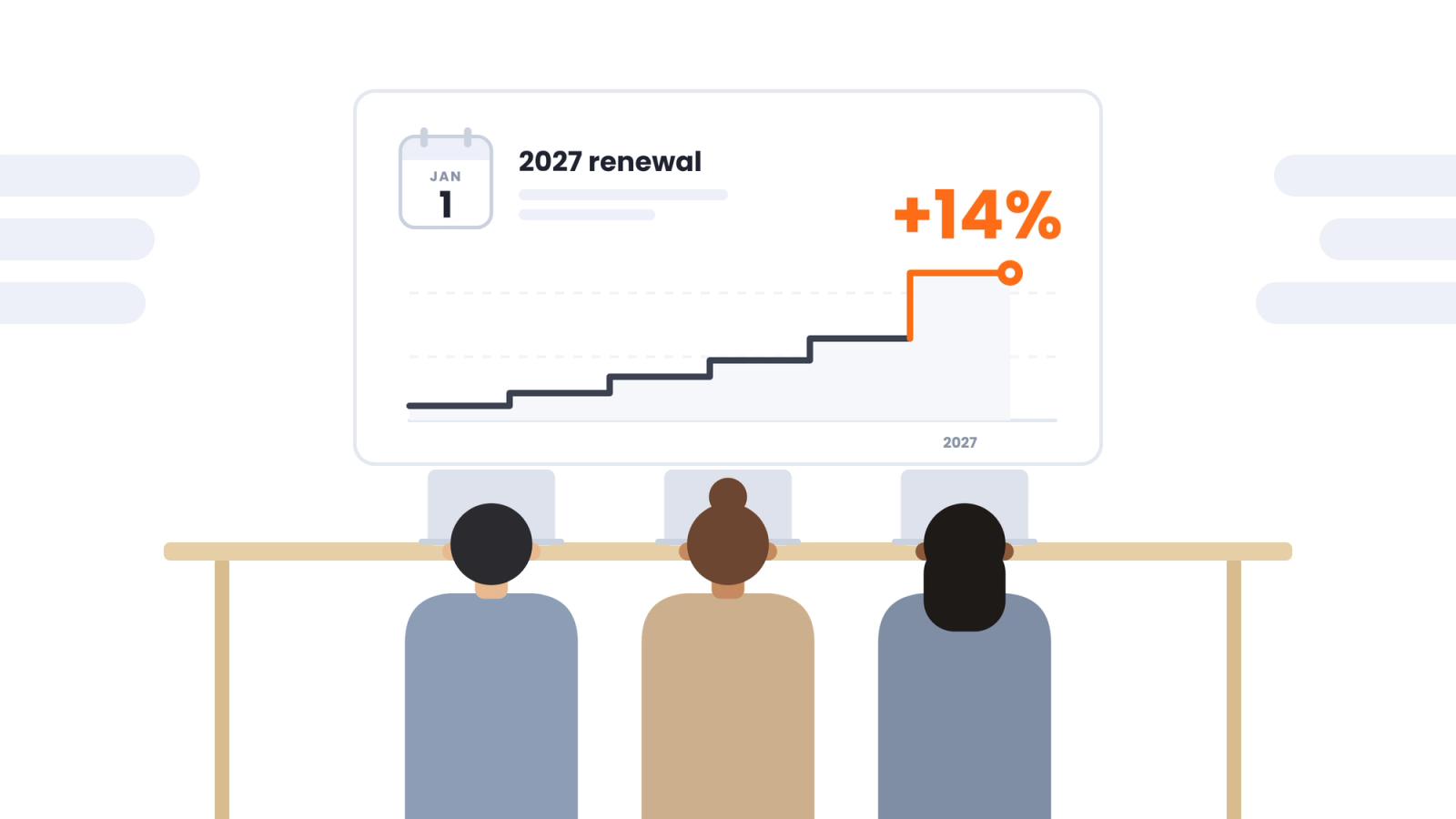
If you renew January 1, the window is now. Get the questionnaires out in October, have quotes in hand by mid-November, and decide before open enrollment materials go out. If your renewal came in high, Your 2027 Health Insurance Renewal Came In High covers the other moves worth making alongside a funding change.
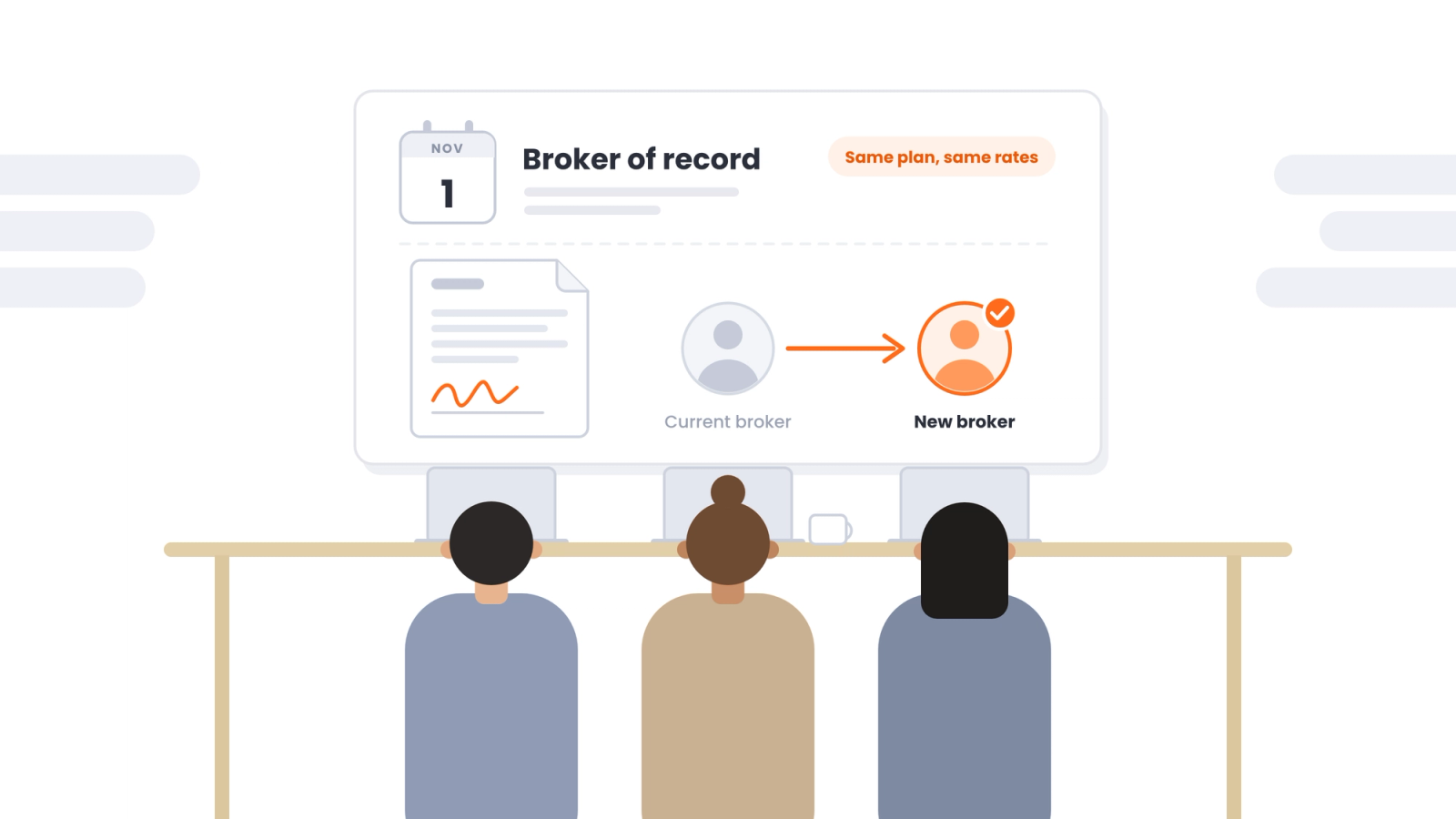
And if your current broker never brought up level-funded, or brought it up without explaining the contract, you can change brokers without changing your plan. The broker of record letter is a one-page change.
FAQ
Is a level-funded plan the same as self-insured?
Legally, yes. It's a self-funded plan with stop-loss insurance and fixed monthly payments. It follows self-insured rules for reporting, nondiscrimination, and state mandates.
Can we owe more than the monthly payment?
Not under a standard level-funded contract. If claims exceed the claims fund, aggregate stop-loss covers the difference. Confirm run-out coverage so there's no final bill if you terminate.
How much of the surplus do we get back?
It depends on the carrier. UnitedHealthcare's California product returns 50%. Kaiser offers 50% or 67% as a credit on renewal. Neither is guaranteed.
Will employees notice the change?
Mostly not. They get carrier ID cards, a familiar network, and normal deductibles and copays. The main thing they'll see is the health questionnaire during underwriting.
Do level-funded plans cover the same benefits?
Usually close, but not necessarily. They don't have to cover the full ACA essential health benefits or state mandates. Compare the plan documents line by line.
Can we switch back to fully insured?
Yes. In the small group market, fully insured coverage is guaranteed issue, so you can move back at renewal if level-funded stops making sense.
What size company is level-funded for?
It's most common between about 20 and 150 employees. It saves the most for healthy groups in the small group market, where fully insured rates ignore your group's health.
Getting a level-funded quote with Sdine
Send us your current renewal and census. We'll get level-funded and fully insured quotes side by side, read the surplus, run-out, and renewal terms for you, and run the light, average, and heavy year math on your actual numbers. If level-funded doesn't beat fully insured for your group, we'll tell you.
Sdine becomes your broker of record: the renewal, open enrollment, carrier issues, and employee questions in Slack, on top of Rippling, Gusto, Deel, ADP, or whatever you already run. It's free, because carriers pay broker commissions that are already built into your premium.
Book a free level-funded quote review
Sources
- KFF: 2025 Employer Health Benefits Survey
- Kaiser Permanente: Level Funded Plan flyer (2025)
- UnitedHealthcare Level Funded, California small group (via Word & Brown)
- NAIC: Stop Loss Insurance Model Act state chart
- healthinsurance.org: what counts as small group
- Georgetown CHIR: self-funding for small employers and ACA protections
- Newfront: compliance considerations for self-insured plans
- HUB International: ACA reporting for level-funded plans
- EY Tax News: PCORI fee rises to $3.84 per covered life (IRS Notice 2025-61)
The Sdine team writes about leaving the PEO, modern benefits, and keeping compliance on autopilot, the AI-native alternative to brokers and PEOs.