The offer letter is the trigger. Not the first paycheck, not the first quarterly filing, not the day someone in finance notices a new state on the payroll register.
That's the part that makes multi-state payroll harder than it looks. Your obligations in a new state attach the moment an employee starts working there. The account numbers you need in order to meet those obligations take somewhere between a few days and six weeks to arrive. Nothing about that sequence is difficult to understand. It's difficult to run, because the work has to happen during the two or three weeks when a hiring manager is thinking about laptops and start dates and nobody is thinking about the Oregon Employment Department.
Most companies find out the same way. Payroll runs, the state gets a W-2 with no matching employer registration, and a notice arrives eight months later.
Here's what actually attaches, how long each piece takes, and where the failure reliably happens.
What a single hire in a new state sets off
Hiring one person in a state where you've never operated is not one registration. It's a stack of them, at different agencies, on different timelines.
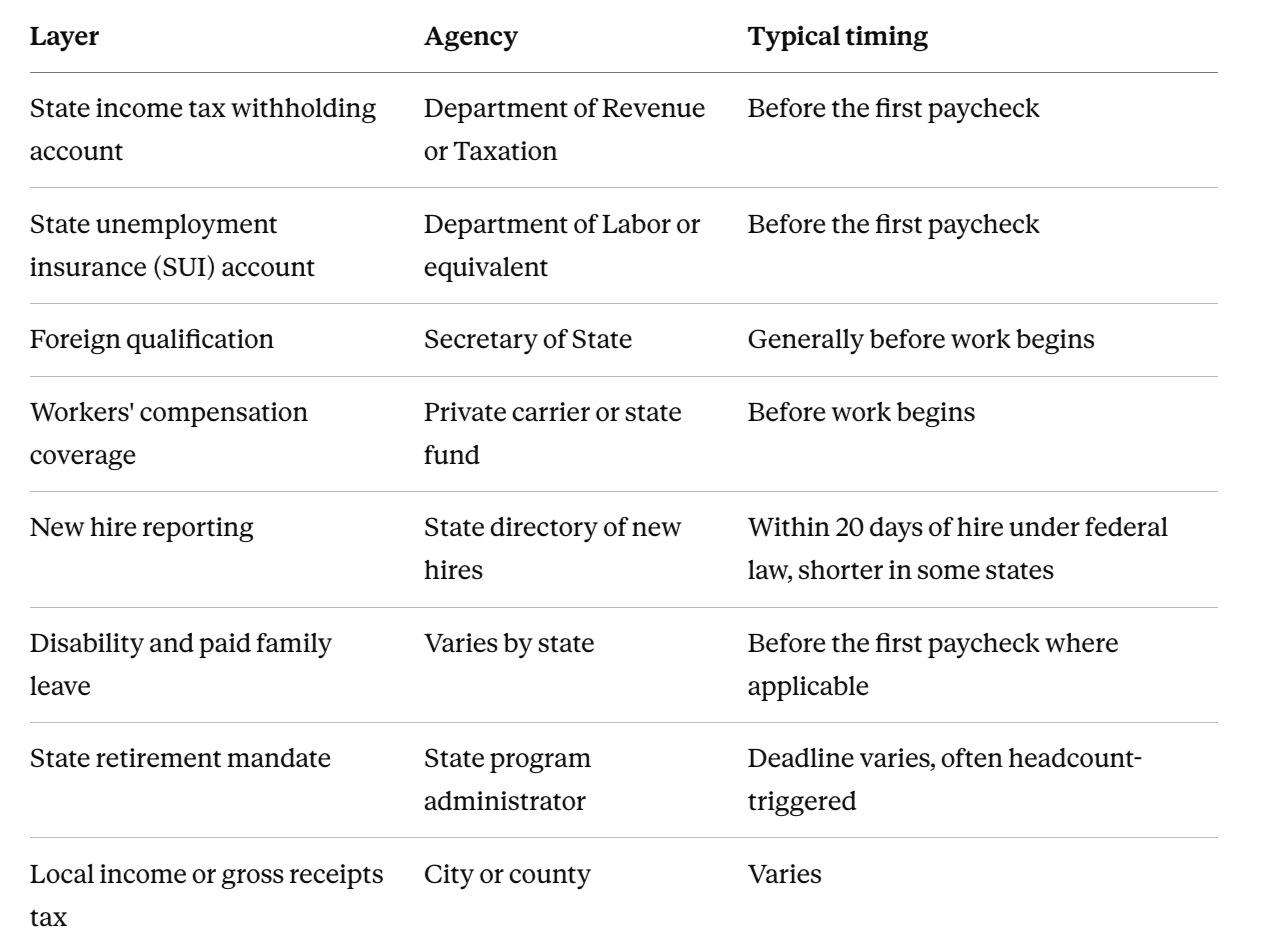
The first two are the ones every payroll provider prompts you for. They're also the ones people worry about most, which is backwards. Withholding and SUI are solved problems as long as somebody flags the new state. It's the rest of the stack that quietly goes unfiled.
Foreign qualification is the one that surprises founders. A remote employee working from their apartment establishes physical presence nexus in that state immediately. Unlike sales tax nexus, there's no revenue threshold to cross and nothing to calculate. It's binary and it happens on day one. Registering typically means a certificate of good standing from your home state, an appointed registered agent with a physical address in the new state, a certificate of authority, and an annual report every year afterward. The consequence of skipping it isn't only a penalty: in many states an unregistered foreign entity can't bring suit to enforce a contract there until it registers and pays what it owes. That's a strange thing to discover in the middle of a customer dispute.
Workers' comp doesn't travel with your existing policy. Coverage is state-specific, and a few states run monopolistic funds where you have to buy from the state rather than your carrier.
New hire reporting is a small obligation with a short fuse. Federal law sets 20 days from hire date; several states require faster. It's easy, it's cheap, and it's forgotten constantly because it doesn't live in payroll.
Disability and paid leave is the layer that's changed most. California, Hawaii, New Jersey, New York, Rhode Island and Puerto Rico run state disability programs. Separately, roughly fourteen states plus Washington, D.C. now have paid family and medical leave programs in some stage of operation, with Minnesota and Delaware launching in 2026 and Maryland's contributions beginning January 2027. Each has its own contribution rate, its own employer-versus-employee split, and its own registration.
State retirement mandates now cover sixteen states. If you sponsor a 401(k) you're generally exempt, but you often still have to file the exemption rather than simply ignore the notice. California's penalties run $250 per eligible employee once noncompliance passes 90 days and $500 per employee at 180 days, which is a real number on a team of twenty in California.
The lead time is the whole problem
Registration processing runs anywhere from a few days to six weeks depending on the state and the agency. You cannot file or remit without the account numbers. So the practical rule is that registration has to start when you extend the offer, not when payroll is due.
Realistically, build 45 to 60 days of lead time before a first payroll in an unfamiliar state. That sounds excessive until you've had an application bounce for a missing certificate of good standing and lost three weeks re-queuing.
Now compare that to how startup hiring actually works. Offer goes out Tuesday. Candidate accepts Thursday. Start date is two weeks out because they want to move fast. Nobody involved in that conversation has the word "Colorado" in their head as a compliance event. The recruiter doesn't. The hiring manager doesn't. The founder approving the comp doesn't. Payroll finds out when the employee shows up in the HRIS with an address.
At that point you're already late, and the options are all bad: run payroll without registration and fix it after, delay the employee's first check, or withhold to the wrong state and unwind it at year end.
The failure is almost never a calculation error
This is worth stating directly, because it changes where you put your attention.
Payroll providers are good at math. Given the right state, they'll compute withholding, SUI, and PFML contributions correctly. The failure mode in practice is upstream of the math entirely: the employer never told the provider that a new state was added.
Everything downstream follows from that one gap. No registration, so no account number. No account number, so no filings. No filings, so no record with the state. Meanwhile the W-2 goes out at year end showing wages sourced to a state where you have no employer registration, and states are increasingly matching that data automatically.
Which means the control that matters isn't a better payroll system. It's a trigger: something that fires on offer acceptance, checks the work location against the states you're already registered in, and starts the registrations when there's still time. Most companies don't have that trigger. They have a person who happens to remember, and that person eventually goes on vacation.
Where withholding gets genuinely hard
Three situations account for most of the real complexity.
Convenience of the employer rules. A handful of states source a remote employee's wages to the employer's state rather than where the person physically works, unless the remote arrangement exists for the employer's necessity rather than the employee's preference. New York, Delaware, Nebraska and Pennsylvania apply full versions. Connecticut and New Jersey apply reciprocal versions that only bite when the employee lives in another convenience-rule state. New Jersey's Division of Taxation publishes its own FAQ on this, which is a decent signal of how often it comes up.
The practical effect: an employee living in one state and working for a company headquartered in a convenience-rule state can owe tax in both. New York is the most aggressive about it and rarely accepts employer-necessity claims without documentation. If your entity sits in one of these states, "work from anywhere" is a tax position, not just a policy.
Reciprocity agreements. Some neighboring state pairs let you withhold only for the employee's home state, but it usually requires the employee to file a specific nonresident certificate with you. Miss the form and you withhold for the wrong state.
No-income-tax states aren't free. Alaska, Florida, Nevada, New Hampshire, South Dakota, Tennessee, Texas, Wyoming and Washington have no personal income tax, so there's no withholding account. You still need SUI registration, workers' comp, and new hire reporting. Washington adds paid family and medical leave plus the WA Cares long-term care payroll tax. Texas has no income tax and one of the more particular SUI registration processes. "No income tax" removes one layer of eight.
The obligations outlive the employee
This is the part almost nobody prices in at the time of hire.
Once you're registered, you're in that state's filing calendar until you formally exit it. Quarterly returns are due whether or not you paid anyone there that quarter, which means zero-dollar returns for as long as the account stays open. Annual reports come due at the Secretary of State. Registered agent fees renew. Missing a zero-dollar return generates a notice exactly the same way missing a real one does.
And when the employee leaves, nothing closes automatically. Deregistration is its own project: closing tax accounts in the right order, filing final returns, withdrawing the foreign qualification, terminating the registered agent. Companies skip it, the accounts stay open, and the notices keep coming for a state where nobody has worked in three years.
Run the arithmetic on a 60-person company in twelve states. Withholding and SUI returns alone, at four to eight filings per state per year, puts you somewhere between fifty and a hundred payroll filings annually before you touch annual reports, PFML remittances, workers' comp audits, or ACA reporting. That's not a hard job. It's a job with a hundred small deadlines and no natural owner, which is a different and worse kind of problem.
The honest conclusion is that the number of states you operate in is a real cost decision, not an HR detail. There's a defensible version of a remote policy that says: we hire in these eighteen states, and adding a nineteenth is a conversation. Plenty of companies would be better off with that constraint than with the one they have now, which is that anyone can move anywhere and finance finds out from a payroll register.
How to actually run this
- Trigger on offer acceptance, not on start date. The moment a candidate accepts, check their work state against your registered footprint. If it's new, registrations start that week.
- Keep a live registration map. One document, one owner: every state, every account number, every filing frequency, every renewal date. Most companies have this scattered across a payroll portal, an email thread, and someone's memory.
- Assume 45 to 60 days. Treat it as a hard constraint on start dates in new states, or accept that you'll be catching up.
- Track relocations, not just hires. An employee moving from Texas to Colorado creates the identical obligation stack as a new hire, and generates zero paperwork to warn you. This is the single most common source of unregistered states.
- Write down which states you hire in. And make adding one a decision someone owns rather than a side effect of a recruiting conversation.
- Close states you've left. Deregister properly instead of letting dormant accounts accumulate notices.
- Handle the non-payroll layers deliberately. Foreign qualification, workers' comp, new hire reporting, PFML, and retirement mandates don't live in your payroll system and won't prompt you.
Where Sdine fits
This is a layer we run directly rather than advise on. Multi-state registration and payroll tax across all 50 states, payroll runs on the stack you already use (Gusto, Rippling, ADP, Justworks, Deel), and notice resolution when a .gov letter lands, including for the dormant accounts nobody remembered to close.
The reason it works economically is the same reason our benefits model works: we're compensated through carrier commissions, not admin fees, so the operational work doesn't carry a per-employee price tag. There's no PEPM on registrations, filings, or notices.
If you're already past 50 employees, the state footprint question also feeds directly into your federal obligations. We covered how those thresholds are counted in crossing 50 employees: which compliance rules actually kick in.
Get a free audit of your state footprint →
The Sdine team writes about leaving the PEO, modern benefits, and keeping compliance on autopilot, the AI-native alternative to brokers and PEOs.