Two health plans appear in your enrollment portal. One costs $120 a month. The other costs $220. You can see the $1,200 annual difference immediately. What you cannot see from those two prices is what happens when you fill a prescription, see a specialist, or need surgery.
A useful comparison puts three things on the same page: what you pay for coverage, what you pay when you use it, and whether the plan covers the care you need.
This guide focuses on comparing health plans offered through a U.S. employer, using your share of the premium and the benefits available to you.
Start with the same documents for every plan
Get the current Summary of Benefits and Coverage, or SBC, for each option. Its standardized format makes it easier to compare deductibles, cost sharing, coverage limits, and exclusions. Ask your benefits team for the SBC if it is missing from your enrollment materials. CMS explains how the SBC supports plan comparisons.
Keep the employee rate sheet, provider directory, and prescription drug list alongside it. Confirm that every document applies to the same plan year and the coverage tier you need: employee-only, employee plus a dependent, or family.
Then compare the plans in the following order.
1. Calculate what comes out of your paycheck
For employer coverage, use the amount you personally pay after the employer’s contribution. If your enrollment portal shows a deduction per paycheck, multiply it by the number of deductions scheduled for the year. Check whether the displayed price is monthly or per pay period.
That gives you the cost of keeping coverage before you receive care. To estimate your total annual spending, add what you expect to pay for services and prescriptions. HealthCare.gov’s total-cost guide explains this distinction.
Keep the premium calculation separate so you can see how much extra you would pay each year for a plan with lower costs when you use it.
2. Read the deductible alongside copays and coinsurance
These numbers describe different parts of your bill:
Term
What it means for your comparison
Deductible
What you pay for services subject to the deductible before the plan begins sharing those costs.
Copay
A fixed charge for a covered service, such as an office visit.
Coinsurance
Your percentage of the allowed cost of a covered service.
Check which services are subject to the deductible. Some plans cover certain visits before you meet it, and prescription drugs may have a separate deductible. With family coverage, ask how each person’s deductible interacts with the family deductible. HealthCare.gov explains these deductible variations.
Coinsurance is calculated from the plan’s allowed amount, which may also be called a negotiated rate.
For each service you use regularly, write down what you would pay before and after meeting the deductible. A specialist visit, therapy appointment, lab test, and prescription may follow different rules within the same plan.
3. Compare your exposure in an expensive year
The in-network out-of-pocket maximum limits what you pay toward covered in-network benefits during the plan year. Eligible deductible payments, copays, and coinsurance count toward that limit. Premiums do not. Noncovered services and many out-of-network expenses sit outside it. HealthCare.gov lists what the out-of-pocket maximum includes and excludes.
For a full year of coverage, calculate:
Annual employee premiums + in-network out-of-pocket maximum
This is a useful budget comparison for a year in which you reach that maximum. You may still have additional expenses outside the plan’s covered in-network benefits.
Do not add the deductible again: amounts that count toward the maximum are already included in it. For family coverage, check both the per-person and family limits in your plan documents.
4. Run the numbers under more than one scenario
Consider these two fictional options for employee-only coverage over a full 12-month plan year:
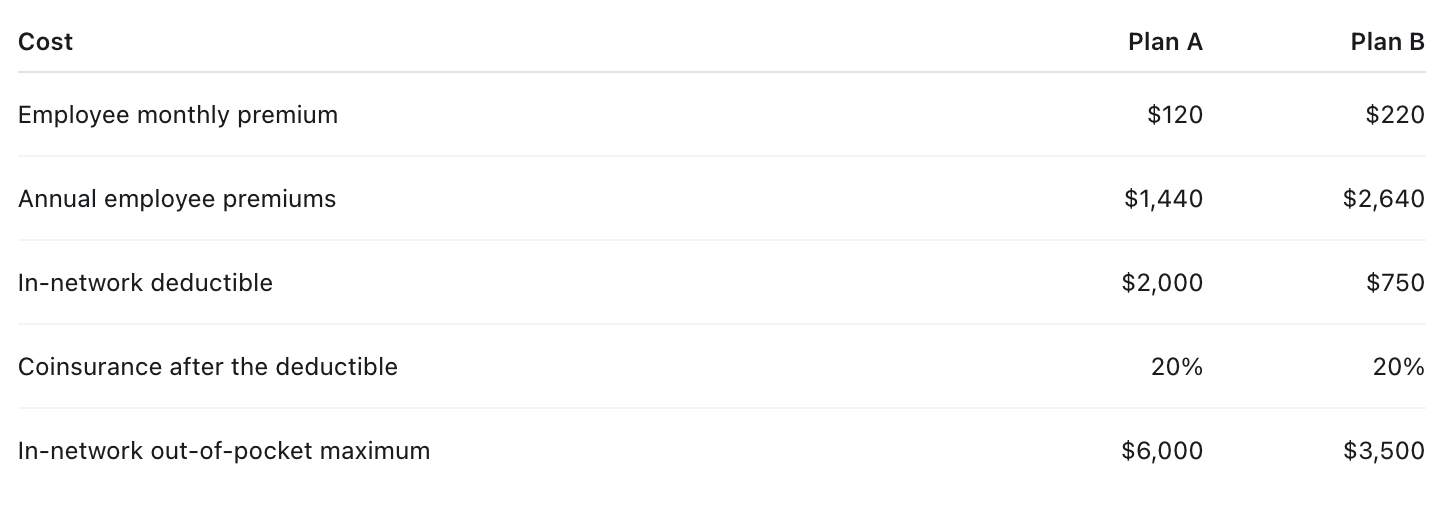
Assume the same care has $6,000 in allowed charges under either plan. All of it is covered, in-network, subject to the deductible, and then subject to 20% coinsurance. Neither plan has additional copays in this example.
Plan A: You pay the $2,000 deductible plus 20% of the remaining $4,000: $2,800 for care. Including premiums, your annual spending is $4,240.
Plan B: You pay the $750 deductible plus 20% of the remaining $5,250: $1,800 for care. Including premiums, your annual spending is $4,440.
Plan A costs $200 less in this scenario, despite its higher deductible.
Now consider a year with enough covered in-network care to reach both plans’ out-of-pocket maximums. Premiums plus that maximum would be $7,440 under Plan A and $6,140 under Plan B.
The result changes with how much care you use. Compare a year with little care, a year based on your expected needs, and a year with substantial expenses.
These are illustrative calculations, not quotes. They exclude employer account contributions and tax effects, and assume identical allowed charges. Actual plans can have different negotiated rates and service-specific rules. The coverage examples inside an SBC can also help you compare plans, but they do not predict your own medical bills. CMS explains how to use those examples.
5. Confirm the doctors and facilities you would use
Search the directory for the exact plan and network you are considering. Check your primary care doctor, specialists, preferred hospital, and any ongoing therapy providers. Confirm participation with the insurer and the provider’s office. HealthCare.gov outlines how to check provider coverage.
Use specific names and locations when you ask. “Do you take this insurer?” is less useful than “Are you in-network for this exact plan at this location?”
If a provider you depend on is outside the network, find out what the plan would pay and what alternatives are available before choosing it. Include that practical difference in your comparison, even if another plan looks cheaper on paper.
6. Check each prescription separately
A formulary is the plan’s list of covered medications. Review yours using the exact drug name and dose, then ask about the applicable deductible, copay or coinsurance, and any approval requirements. Confirm that your pharmacy participates in the plan’s network. HealthCare.gov explains how to verify medication and pharmacy coverage.
Estimate a full year’s cost for medications you take regularly. A modest monthly difference can materially change the comparison between plans.
7. Consider when you would need the money
Annual totals leave out the timing of expenses. In the example above, Plan A saves $100 a month in premiums, but could require you to pay its $2,000 deductible early in the year if you need care.
Consider whether you could comfortably handle that bill when it arrives. If your employer offers an HSA or HRA contribution, check the amount, when it becomes available, and which expenses it can cover before including it in your budget.
Before you enroll, fill in these seven lines
For each plan, record:
- My annual premium contribution: $___
- My estimated spending in a typical year, including premiums: $___
- Annual premiums plus the applicable in-network out-of-pocket maximum: $___
- My doctors and preferred facilities are in-network: confirmed / unresolved
- My regular prescriptions are covered, and I understand their costs and requirements: confirmed / unresolved
- Employer account funds I can use, and when they become available: ___
- The early-year bill I could comfortably pay: $___
Resolve the gaps with your benefits team or insurer before submitting your election. Keep a copy of the plan documents and your enrollment confirmation so you can refer to the coverage you selected when you start using it.
The Sdine team writes about leaving the PEO, modern benefits, and keeping compliance on autopilot, the AI-native alternative to brokers and PEOs.