There's a version of this article on every HR blog, and they all say roughly the same thing: at 50 employees, FMLA and the ACA kick in. That's true enough to be useless.
Fifty isn't one threshold. It's a cluster of separate rules, each with its own definition of "employee," its own counting period, and its own start date. Two of the rules people file under "the 50-employee stuff" don't trigger at 50 at all. And the expensive one, the ACA employer mandate, is calculated on last year's average, which means it lands a full calendar year after you actually grew past the line.
That lag is the whole problem. By the time your headcount reads 50, the year that determines your obligation is already mostly written. The decisions that would have changed the cost got made, or didn't, months ago.
This post is the counting mechanics. What each rule measures, when it starts, what it costs to get wrong at 2026 rates, and what you can still do inside the window you have left.
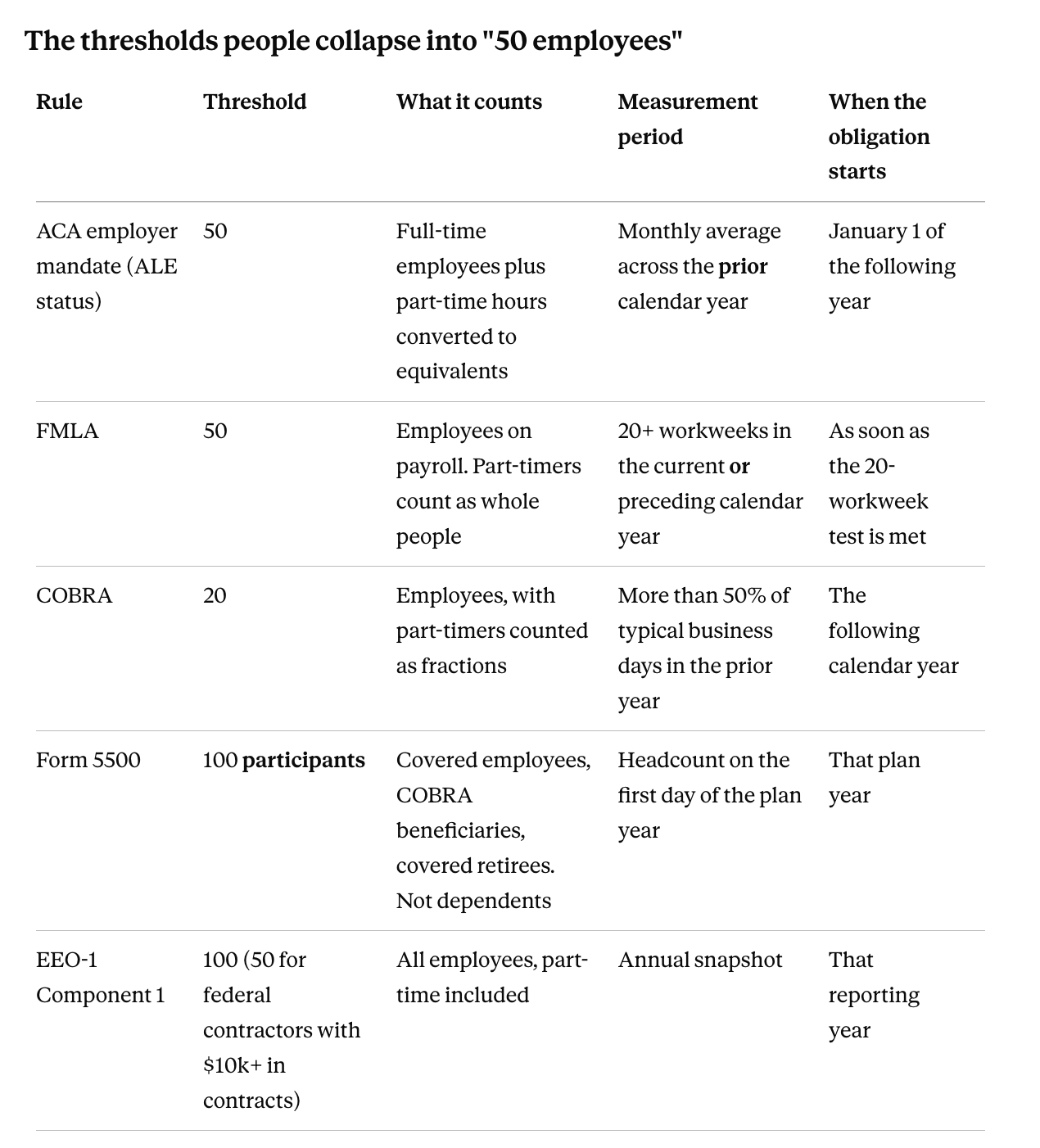
The thresholds people collapse into "50 employees"
The ACA count is not your headcount
Under the ACA, an applicable large employer is one that averaged 50 or more full-time employees, including full-time equivalents, across the prior calendar year. Full-time means 30 hours a week or 130 hours a month.
The full-time equivalent math is where teams get surprised. For each month, you add up the hours worked by everyone who isn't full-time, cap each person's contribution at 120 hours, and divide the total by 120. That gives you the FTE count for that month. Add it to your full-time count. Do that for all twelve months, average the results, and drop the decimals. The IRS lays out the calculation here.
Worked through with real numbers: say you have 44 salaried full-time employees and 12 part-time contractors-turned-W2 working about 80 hours a month each. That's 960 part-time hours, divided by 120, which is 8 FTEs. Your count for that month is 52. Your HRIS says 44 people are full-time. Your org chart says 56 humans. The number that matters is 52, and none of your systems display it.
Two exceptions worth knowing. Employees covered by VA or TRICARE health programs don't count toward the ALE determination. And there's a narrow seasonal carve-out: if you exceed 50 for 120 days or fewer in the year and the employees who pushed you over were seasonal workers, you're not an ALE. It's narrower than most people assume. Cross for 121 days and it doesn't apply.
The year of lead time almost nobody uses
Here's the part that gets missed.
If your monthly average across 2026 lands at 50 or more, you are not an applicable large employer in 2026. You become one on January 1, 2027. The mandate applies to a plan year you are designing right now, in the back half of 2026, before an open enrollment that hasn't happened yet.
So the sequence looks like this. You cross 50 in headcount somewhere around March. Nothing happens. You finish the year at 63 people. Still nothing. January 1, 2027 arrives and you are suddenly on the hook to offer minimum-value, affordable coverage to at least 95% of your full-time employees, with the first Forms 1094-C and 1095-C due in early 2028 for the 2027 year.
The gap between crossing and owing is where all the leverage lives. Affordability safe harbor selection, contribution strategy, plan tiering, whether you use the monthly measurement method or the look-back measurement method, waiting period design: every one of those is a decision you make before the plan year starts, and every one of them changes what compliance costs you.
Almost nobody uses that window, because nothing in the growth of a company tells you the clock started. Headcount crossing 50 doesn't generate an alert. The lawyer doesn't call. The PEO or broker sends the same renewal packet it sent last year. The first signal most teams get is an IRS notice two years later, which is the worst possible time to learn how the count works.
What getting it wrong costs, at 2026 rates
Two penalties, both indexed annually, both raised meaningfully for 2026.
Section 4980H(a), the one people call the sledgehammer, applies if you fail to offer minimum essential coverage to at least 95% of your full-time employees and their dependent children, and at least one full-time employee gets a premium tax credit on the exchange. For 2026 it's $3,340 per year, or $278.33 a month, multiplied by your entire full-time count minus the first 30.
Run that at 60 full-time employees: 60 minus 30 is 30, times $3,340, which is $100,200 for a single year. Not per violation. That's the annual exposure for one bad plan design, and it's triggered by a single employee going to the exchange.
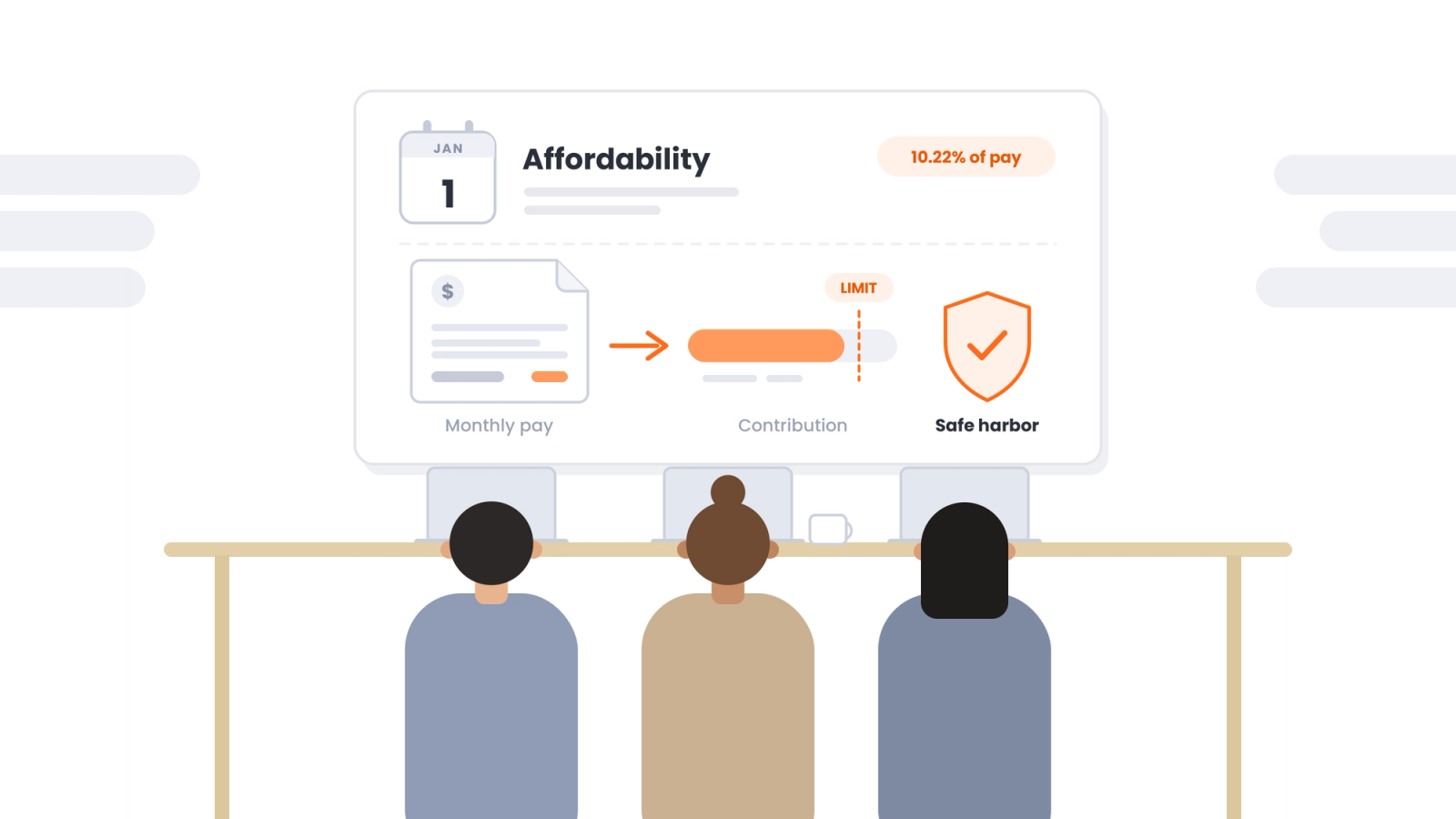
Section 4980H(b) applies when you did offer coverage but it wasn't affordable or didn't meet minimum value. It's $5,010 per year, $417.50 a month, assessed per affected employee rather than across the whole workforce. For 2026, coverage is affordable if the employee's required contribution for the lowest-cost, self-only, minimum-value plan doesn't exceed 9.96% of household income, or one of the three safe harbors: W-2 wages, rate of pay, or federal poverty level. That 9.96% figure is the highest affordability threshold in the law's history.
Two things worth saying plainly about who carries this.
First, reporting penalties stack on top. Because the 1095-C exists in both an IRS-filed copy and an employee-furnished copy, a single error can be assessed twice under Sections 6721 and 6722.
Second, being in a PEO does not move this liability. PEO co-employment simplifies the administration, but employer mandate liability under 4980H generally stays with the client employer as the common-law employer. Plenty of teams at 50 to 150 people assume TriNet or Insperity absorbed this. They didn't. If you're weighing that structure more broadly, we walked through the full cost picture in PEO vs Sdine: the real cost math at 30, 75, and 150 employees.
FMLA counts differently, and it usually arrives sooner
FMLA ignores the FTE math entirely. It counts employees on the payroll, and a 15-hour-a-week part-timer counts as one whole person, the same as a director.
The test is 50 or more employees for 20 or more calendar workweeks, not necessarily consecutive, in the current or the preceding calendar year. That "or" does real work. Because it looks at the current year too, FMLA can attach mid-year while ACA status is still a year out.
FMLA coverage is also sticky in a way that catches people during a contraction. Once you're covered, you stay covered until you fail the 20-workweek test in both the current and the preceding year. Drop below 50 in 2026 and you're still a covered employer through 2027.
One more wrinkle that matters for distributed teams: employer coverage and employee eligibility are separate questions. An individual employee is only eligible if the company has 50 or more employees within 75 miles of that person's worksite. So a 70-person company with people in fourteen states can be a covered employer while a large share of its workforce is ineligible. That's an awkward thing to discover when someone requests leave, and an even more awkward thing to discover after you've already told them yes.
The two thresholds that aren't 50 at all
COBRA triggers at 20, not 50, and it triggers earlier than most teams expect. The federal rule applies to employers with 20 or more employees on more than 50% of typical business days in the prior calendar year. If you're reading this at 50-plus, COBRA has applied to you for a while. Most states also run mini-COBRA programs for smaller employers, with their own rules.
Form 5500 triggers at 100 participants, not 100 employees, and the distinction costs people filings. Participants means covered employees, COBRA-qualified beneficiaries, and covered retirees. Dependents don't count. The test runs on the first day of the plan year, so crossing mid-year changes nothing until the next one.
The trap is wrap plans. If you've wrapped medical, dental, and vision into a single ERISA plan document, the count is distinct participants across the whole wrap. So 70 on medical, plus 20 dental-only people who aren't on medical, plus 12 vision-only people on neither, gets you to 102. You're filing, and the plan you thought was well under the line isn't. Note also that the small-plan exemption only covers plans that are unfunded or fully insured. Any plan funded through a trust files regardless of size.
EEO-1 is 100 employees for most private employers. It drops to 50 for federal contractors holding at least $10,000 in contracts, which is why "50" gets attached to it in blog posts written for a general audience.
Multi-state makes the count harder, not just the filings
Remote employees count toward every federal threshold regardless of where they sit. A fully distributed 55-person company hits ALE status identically to one company in one office. What changes is everything downstream.
Each new state means a new set of employer registrations, payroll tax accounts, and filing calendars. State-level rules layer on top of the federal ones: mini-COBRA, state paid family leave programs with their own headcount triggers and contribution requirements, and state-level ACA reporting in California, New Jersey, Rhode Island, Massachusetts, and Washington, D.C. Vermont maintains an individual mandate but doesn't currently impose separate employer reporting, which is the kind of detail that gets a company either over- or under-filing.
Federal ACA reporting itself has changed shape recently, and it's changed in your favor. The Paperwork Burden Reduction Act and the Employer Reporting Improvement Act, both effective from the 2024 filing cycle onward, mean ALEs no longer have to mail a 1095-C to every full-time employee. You can instead post a clear, conspicuous notice on your benefits site telling employees they can request one, keep it up through mid-October, and furnish within 30 days of any request. The notice has to include an email address, a physical address, and a phone number. Most teams we talk to are still mailing, because nobody told them the rule changed.
The e-filing threshold moved too. Any employer filing 10 or more information returns in aggregate across the year, counting W-2s and 1099s alongside 1094s and 1095s, has to file electronically. That's effectively every ALE. Paper is gone.
This is the layer Sdine runs directly. Multi-state registration and payroll tax across all 50 states, ACA, ERISA, COBRA and 5500 compliance with the filings prepared and tracked, and notice resolution when a .gov letter shows up. It's part of the operating cost of a growing company that nobody wants to hire for.
What to do in the year before you cross
If your monthly average is trending toward 50 this year, here's the sequence that actually matters, in order.
- Calculate your real FTE average monthly, not your headcount. Full-time count plus part-time hours divided by 120, tracked as a running twelve-month average. If it reads 47 in August, you have information. If you find out in January, you have a problem.
- Pick your measurement method before the plan year, not during it. Look-back versus monthly determines who counts as full-time for variable-hour and part-time staff, and it's very hard to change once you've applied it.
- Choose an affordability safe harbor and apply it consistently. W-2, rate of pay, or FPL. Mixing methods across similarly situated employees is its own exposure, separate from the underlying affordability failure.
- Model your lowest-cost self-only plan against 9.96% before you set contributions, not after. Affordability is tested on that specific plan, not your average premium.
- Reconcile your ERISA participant count across the whole wrap, including dental-only and vision-only enrollees, so a Form 5500 obligation doesn't surprise you on day one of the plan year.
- Map your state footprint against paid leave, mini-COBRA, and state reporting triggers. Every new state is a new calendar.
- Write the FMLA policy before someone requests leave. Including the 75-mile eligibility question for distributed staff, which you want answered in a document rather than in an email thread with an employee who's already made plans.
The through-line: almost every item on that list is cheap to do in advance and expensive to do late. That's the actual shape of the 50-employee cliff. Not that the rules are hard, but that they're measured on a period that's over by the time you notice.
Where this connects to the rest of the stack
If you're crossing 50 inside a PEO, the compliance question and the cost question arrive together. The mandate liability stays with you either way, but your ability to design around it depends on whether you can see and shape your own plan. We covered that in the five signals your startup has outgrown its PEO, and the operational sequence in the 90-day PEO exit playbook.
Sdine runs benefits, compliance, and people ops for companies in exactly this range, and it's free to the employer. We're paid through carrier commissions, the same way any broker is. If you're approaching 50 and want to know what your actual FTE average is and what it will cost you in the plan year after next, we'll run the numbers.
Get a free compliance and cost audit →
The Sdine team writes about leaving the PEO, modern benefits, and keeping compliance on autopilot, the AI-native alternative to brokers and PEOs.